About Eacles imperialis Drury, 1773
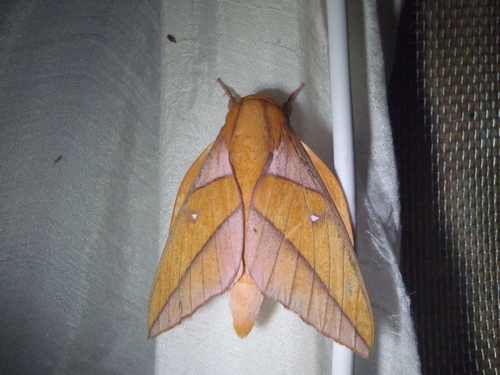
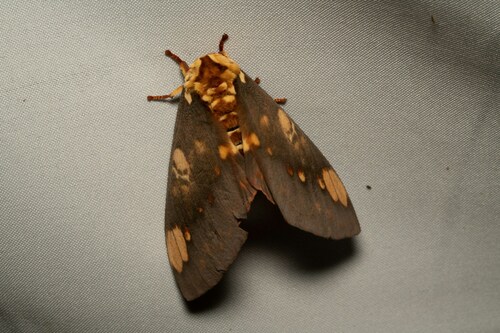
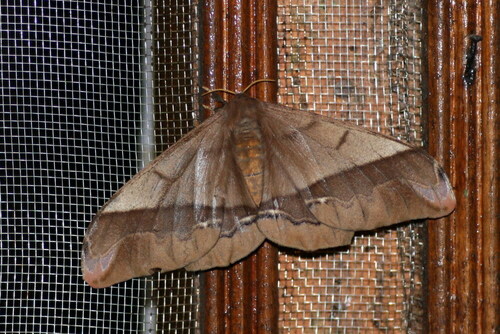
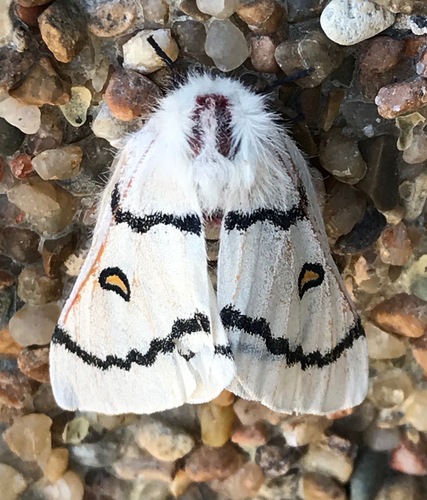
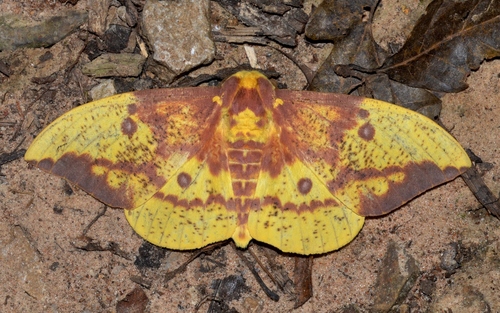
Eacles imperialis, the imperial moth, has an adult wingspan ranging from 80 to 175 mm, which equals 3+1⁄8 to 6+7⁄8 inches. This species shows a very high level of individual variation. Adult moths are always primarily yellow, with distinct red, brown, and purple blotches, though the exact pattern and shade of these markings can vary a great deal between individuals. Both light and dark morphs of the species occur across the northern and southern parts of its range, and individuals from the northern portions of its native range generally have fewer dark markings. Imperial moth larvae change dramatically across their instars. In the first instar, larvae are small at approximately 10–15 mm long, orange with black transverse bands and large spines. By the fifth instar, they reach 75–100 mm (3–5.5 inches) in length, with long hairs and shorter spines. Larvae also have two common color morphs: one is dark brown to burgundy with white spiracle patches, and the other is green with yellow spiracle patches. The imperial moth and its many regional morphs, subspecies, and closely related sibling species have a broad range extending from Argentina north to Canada, and from the Rocky Mountains east to the Atlantic Coast of North America. Within its genus Eacles, E. imperialis is the species with the widest overall range, and it also reaches the northernmost latitude. The nominate subspecies Eacles imperialis imperialis was historically recorded from New England and southern Canada, south to the Florida Keys, and as far west as Nebraska. Today, the nominate subspecies is no longer found across most of Massachusetts, with the exception of an existing population on Martha's Vineyard. The true northern boundary of the nominate subspecies' range is not confirmed, because older records may confuse it with the subspecies E. i. pini. The subspecies E. i. pini lives in coniferous and transition zone woodlands along the northern edge of the range in New England and the Great Lakes States, and extends north into Canada. In the southwestern United States, E. imperialis is replaced by the closely related species E. oslari. Additional subspecies are found in Mexico and South America; the subspecies E. i. magnifica occurs in Brazil and the surrounding areas. In southern locations like Florida, a small number of adult imperial moths emerge in spring or early summer, while the majority emerge in late summer. The species produces only one brood per year. Imperial moth larvae are polyphagous and have been recorded feeding on a wide variety of host plants, though food preferences likely differ between regions. The most commonly reported host plants for this species are pine species, maple species, oak species, sweetgum, and sassafras.