About Dyspanopeus sayi (Smith, 1869)
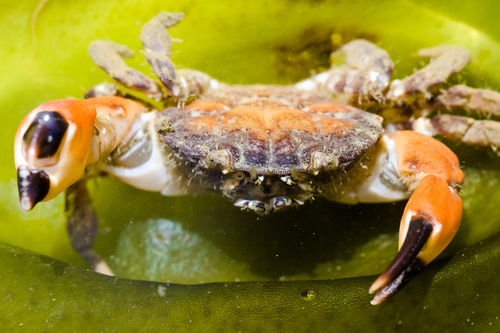
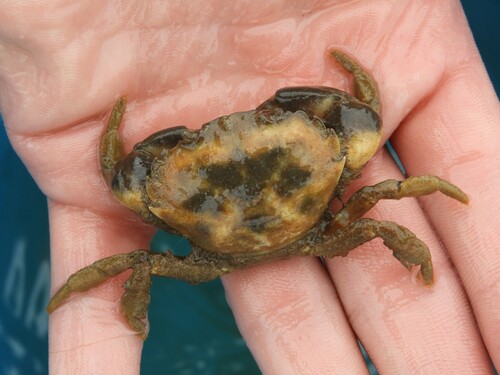
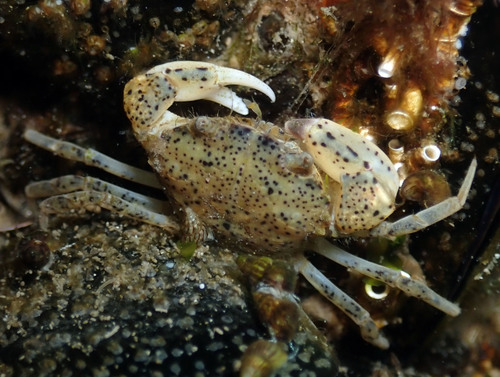
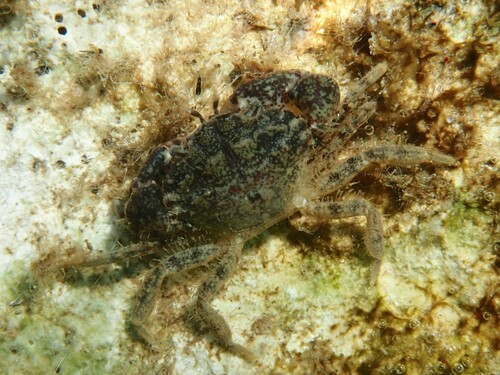
Dyspanopeus sayi (Smith, 1869) is a small species of crab that resembles Eurypanopeus depressus in appearance. Adults reach a maximum carapace width of 20 millimetres (0.8 in), while sexually mature females have a carapace that is at least 6.1 millimetres (0.24 in) wide. The roughly hexagonal carapace is 1.3 to 1.4 times as wide as it is long, and is strongly convex. It has a finely granular surface, with a light covering of hair that is thicker toward the front and sides. Dyspanopeus sayi has unequal chelae (claws): the right chela is stouter, while the left chela is narrower. The carapace ranges in color from olive-green to brown, and the tips of the claws are black. The native range of Dyspanopeus sayi stretches from Baie des Chaleurs in eastern Canada to the Florida Keys in the southeastern United States. It inhabits areas from the intertidal zone down to depths of 46 metres (151 ft), and can tolerate a wide range of temperatures and salinities. Dyspanopeus sayi has also been recorded at multiple locations across Europe. It was first spotted in Swansea Docks, south Wales, in 1960, after being accidentally introduced via trans-Atlantic shipping. The first record of the species in the Mediterranean Sea came in 1993, when it was found in the Venetian Lagoon in north-eastern Italy, though researchers believe it had been present in the area since the late 1970s. In 2007, the species was recorded on the North Sea coast of the Netherlands. It was discovered in Constanța harbour, Romania, in the Black Sea in 2010, and in the Ebro delta of the Balearic Sea, in the western Mediterranean Sea, in 2012. Dyspanopeus sayi lives mostly on muddy bottoms, where it acts as a predator of bivalve molluscs. In its native range, it hides among polychaete colonies to avoid predation by the Atlantic blue crab, Callinectes sapidus. It is an important predator of the quahog Mercenaria mercenaria in Narragansett Bay, and of the barnacle Balanus improvisus in Delaware Bay. In the Adriatic Sea, it has been observed feeding on the striped venus clam Chamelea gallina and the introduced Asian date mussel Arcuatula senhousia. The life cycle of Dyspanopeus sayi begins with copulation, which usually occurs shortly after the female molts, while her exoskeleton is still soft. Spawning happens within hours or days after copulation, and the female broods the attached eggs on her pleopods (swimmerets) until they are ready to hatch. Egg-carrying females have been found between April and October. A 1978 study of crabs caught at Gloucester Point, Virginia found that females carried between 686 and 14,735 eggs. The number of eggs increases with carapace width following a power law; extrapolation from this relationship indicates that the largest Dyspanopeus sayi females can carry more than 32,000 eggs each. At a temperature of 29 °C (84 °F), egg development takes only 9 or 10 days. Development time increases to 16 days at 20 °C (68 °F). Young crabs hatch as zoea larvae, then go through three more zoeal stages and one megalopa stage before developing into juvenile crabs. Juveniles are thought to reach sexual maturity in the summer after hatching. Individual Dyspanopeus sayi can live up to 2 years.