About Dysithamnus stictothorax (Temminck, 1823)
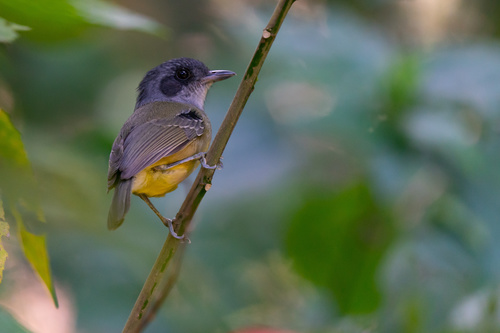
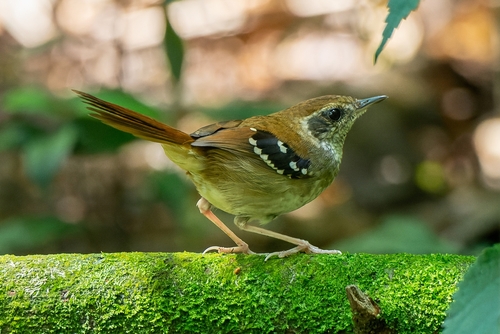
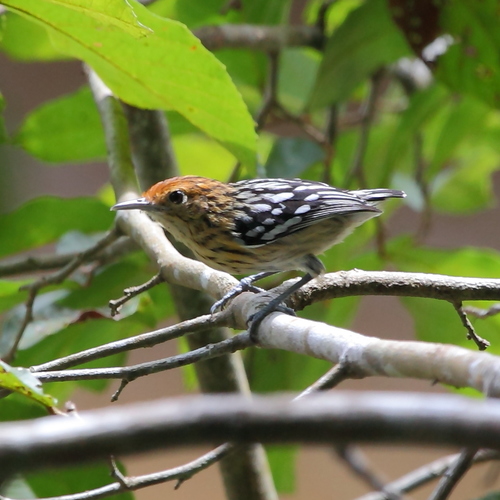
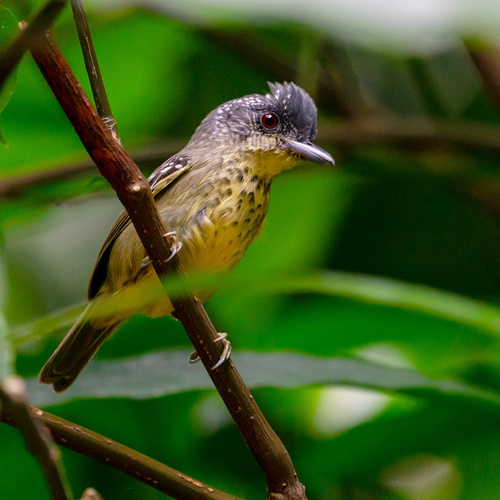
This species, commonly called the spot-breasted antvireo, has a scientific name of Dysithamnus stictothorax (Temminck, 1823). The spot-breasted antvireo reaches approximately 12 cm (4.7 in) in length. Adult males have a dark gray forehead and crown, blackish ear coverts, and white spots on the sides of the head. Their upperparts are grayish olive, with a hidden white patch located between the scapulars. Their wings are blackish, with wide chestnut-rufous edges on the flight feathers and white tips on the coverts. Their tail is rufous-olive, with narrow white tips on each feather. Their throat and upper breast are white, and most of the rest of their underparts are yellowish. Large dark spots mark their breast, and the sides of their underparts have a grayish tone. Adult females have a chestnut crown. Their upperparts and wings are more olive and less gray than those of males, and they lack the white interscapular patch. They also have fewer spots on their underparts than males do. The spot-breasted antvireo is distributed in coastal southeastern Brazil, ranging from southeastern Bahia south to Santa Catarina, and occurs somewhat further inland in Minas Gerais. While some sources list the species' range as including Misiones Province in northeastern Argentina, the South American Classification Committee of the American Ornithological Society has no confirmed records of the species from that area. The spot-breasted antvireo lives in the understorey to mid-storey of evergreen forest in lowland and lower montane regions. It prefers forest edge habitats, such as areas along roads and around natural clearings. Its elevation range extends from sea level up to 1,250 m (4,100 ft).