About Dysithamnus puncticeps Salvin, 1866
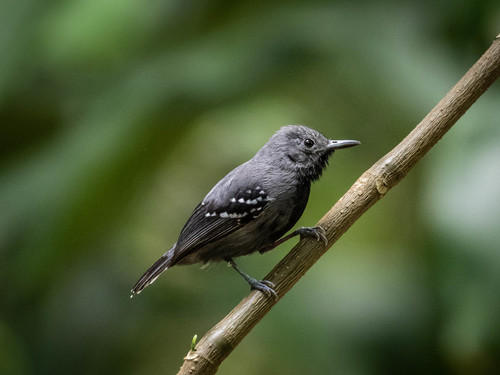
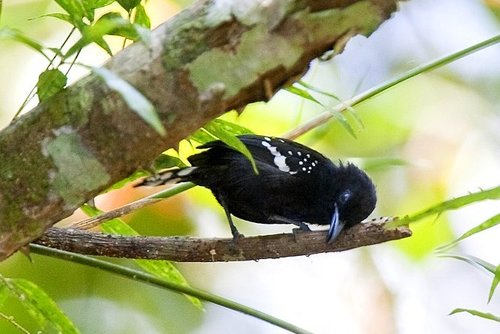
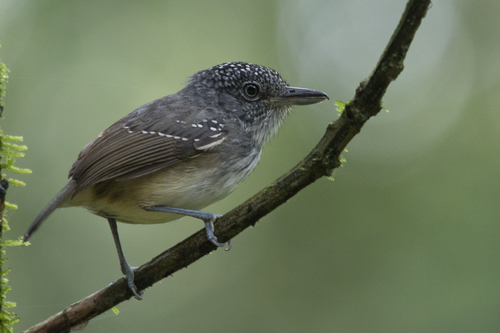
Dysithamnus puncticeps Salvin, 1866, commonly called the spot-crowned antvireo, measures 10 to 12 cm (3.9 to 4.7 in) in length and weighs 15 to 17 g (0.53 to 0.60 oz). Adult males have a dark gray forehead, crown, and nape that are heavily marked with white spots, and grayish ear coverts. Their upperparts are grayish olive, with a hidden white patch between the scapulars. Their flight feathers are dark grayish olive with wide buffy grayish edges, while their wing coverts are blackish with white tips. Their tail is dark grayish olive with white tips on each feather. Their throat, breast, and upper belly are white with dark streaks, their sides are olive-gray, and their lower belly and undertail coverts are whitish with an ochraceous tinge. Adult females have a rufous crown and nape with dark spots and pale buff ear coverts. Their wing coverts are less black than those of adult males. Their throat, breast, and belly center are pale buff, while their sides, flanks, lower belly, and undertail coverts are ochraceous. The spot-crowned antvireo is distributed from Cahuita in Costa Rica's Limón Province, south through Panama along the Caribbean slope, and along the Pacific slope starting from Panamá Province. Its range extends into Colombia along the lower reaches of the Cauca River and the country's Pacific slope, continuing into northwestern Ecuador as far as the Manabí and Santo Domingo de los Tsáchilas provinces. This species primarily inhabits the understorey to mid-storey of evergreen forest in the lowlands and foothills. Its elevation range reaches from sea level to 800 m (2,600 ft) in Costa Rica, to 500 m (1,600 ft) in Panama, to 1,000 m (3,300 ft) in Colombia, and to 800 m (2,600 ft) in Ecuador.