About Dysithamnus mentalis (Temminck, 1823)
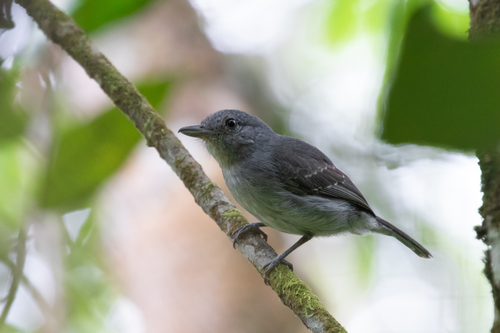
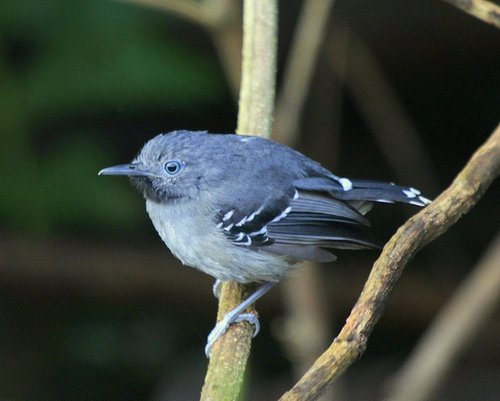
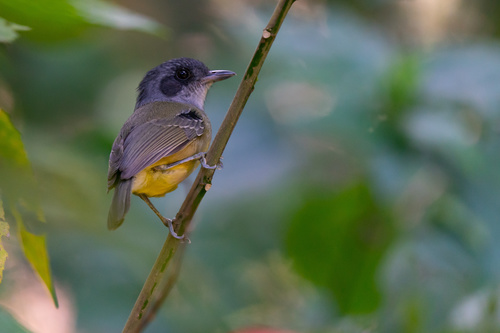
Dysithamnus mentalis, commonly called the plain antvireo, is 10 to 13 cm (3.9 to 5.1 in) long and weighs 12 to 16 g (0.42 to 0.56 oz). It is a rather chunky bird with a large head and short tail. Adult males of the nominate subspecies D. m. mentalis have a dark gray forehead and crown and blackish ear coverts. Their upperparts are grayish olive with a hidden white patch between the scapulars. Their wings are dark grayish olive with olive edges on the flight feathers, white tips on the grayish olive greater coverts, blackish median coverts with white tips, and blackish lesser coverts. Their tail is dark grayish olive with narrow white tips on the feathers. Their throat and upper breast are white with light gray spots and their sides olive gray. Their lower breast, flanks, and crissum are pale gray and the center of their belly yellow. Adult females have a cinnamon-tawny crown. Their upperparts and wings are more olive and less gray than the male's and they lack the white interscapular patch. Their wing coverts and the edges of their flight feathers are olive-yellow. Their underparts have more extensive yellow than do males'. Other subspecies of the plain antvireo differ from the nominate and each other as follows: D. m. viridis is like the nominate; D. m. cumbreanus is like the nominate; D. m. emiliae is like the nominate. D. m. septentrionalis has a male that is grayer than the nominate with a yellowish belly, and a female that is overall browner. D. m. suffusus has a male that is slightly paler than septentrionalis. D. m. affinis has a male somewhat paler than suffusus, with a white belly center, and a female that has warm brown upperparts. D. m. andrei has a male slightly darker than affinis, and a female duller brown than affinis. D. m. oberi has a male like andrei, and a female with yellower underparts. D. m. extremus has a male with a blackish crown, and is otherwise like the nominate. D. m. semicinereus has a male with almost pure gray upperparts that have just a hint of olive, a grayer tail than the nominate, and gray throat and underparts with a white belly center and faint yellow tinge on the lower belly and flanks; the female has a more tawny crown and even less gray tone on the upperparts than the nominate, clay colored edges to flight and tail feathers, an olive-brown tinge to the throat, a light olive-brown breastband, a white upper belly that becomes yellowish olive on the lower belly, and olive sides and flanks. D. m. spodionotus has a male darker than semicinereus; the female is warm ochraceous with a white throat and belly. D. m. ptaritepui is similar to spodionotus but the male is not as dark. D. m. tavarae is similar to spodionotus but the male is not as dark. D. m. olivaceus has a male slightly more olive than ptaritepui and tavarae. D. m. napensis has a male paler than olivaceus with less yellow than the nominate; the female's underparts are drab buffy-olive with no yellow. D. m. tambillanus is like napensis. D. m. aequatorialis has a male's underparts much paler than those of napensis and tambillanus, with a pale yellow belly and gray tinge on the flanks. There is some question about the validity of all the subspecies, with some possibly representing clinal variation rather than true subspeciation. Molecular studies are needed in order to establish relationships among populations. The plain antvireo has an oddly shaped and disjunct distribution. The subspecies are distributed as follows: D. m. septentrionalis ranges from Campeche, Tabasco, and Chiapas in southeastern Mexico south on the Caribbean slope through Belize, Guatemala, Honduras, and locally in Nicaragua, to the Caribbean and Pacific slopes of Costa Rica and Panama to the Panama Canal. D. m. suffusus is found on the Caribbean and Pacific slopes of Panama from the Canal into Chocó and Antioquia departments in extreme northwestern Colombia. D. m. extremus occurs in Colombia's Western Andes and west slope of the Central Andes between Antioquia and Cauca Department. D. m. semicinereus occurs on the east slope of Colombia's Central Andes and both slopes of the Eastern Andes between Santander and Caquetá departments. D. m. viridis is found in northern Colombia from La Guajira Department south to Santander Department, and in northwestern Venezuela's Sierra de Perijá and the western Andes of Zulia, Mérida, and Táchira states. D. m. cumbreanus occurs in northern Venezuela's Coastal Ranges from Falcón and Lara east to northern Sucre. D. m. andrei occurs in northeastern Venezuela from Sucre to Bolívar, western and southern Guyana, and Trinidad. D. m. oberi occurs on Tobago. D. m. ptaritepui occurs on the tepuis of southeastern Venezuela's Bolívar state. D. m. spodionotus ranges from Bolívar and Amazonas states in southern Venezuela into northern Roraima in extreme northern Brazil. D. m. aequatorialis occurs on the Pacific slope from Ecuador's Esmeraldas Province south into the Department of Tumbes in extreme northwestern Peru. D. m. napensis occurs on the eastern slope of the Andes from extreme southern Colombia south through eastern Ecuador into extreme northern Peru's Amazonas Department. D. m. tambillanus occurs on the eastern slope of the Andes in northern and central Peru south to Huánuco and Ucayali departments. D. m. olivaceus occurs on the eastern slope of the Peruvian Andes between Pasco and Madre de Dios departments. D. m. tavarae ranges across the Andes from Madre de Dios in southeastern Peru south into central Bolivia as far as southwestern Santa Cruz Department. D. m. emiliae occurs in northeastern Brazil roughly bounded by northeastern Pará, Paraíba, northern Tocantins, and Alagoas. D. m. affinis occurs in northeastern Santa Cruz in extreme northeastern Bolivia and central Brazil roughly bounded by southern Mato Grosso, southern Tocantins, northern Goiás, and northern Mato Grosso do Sul. D. m. mentalis (the nominate subspecies) ranges in east-central and southeastern Brazil from eastern Bahia south through Rio Grande do Sul and into eastern Paraguay and northeastern Argentina's Misiones Province. Subspecies D. m. andrei is known in Guyana in the Pakaraima Mountains (though not Mount Roraima) and the southern Acari Mountains; as of 2007 it had not been recorded in the Iwokrama Forest or the Potaro Plateau. The plain antvireo inhabits a variety of landscapes across its wide range. In Mexico and Central America it occurs in the understorey to mid-storey of humid montane evergreen forest and mature secondary forest. In the northern part of this area it ranges in elevation from sea level to 1,500 m (4,900 ft), though mostly below 1,250 m (4,100 ft), while in Costa Rica it reaches 2,500 m (8,200 ft) though only rarely. In the northern mountains and tepuis of Venezuela and in the Andes from Venezuela and Colombia to Bolivia it occurs in humid evergreen forest, and also in semi-deciduous and deciduous forest and woodlands. In Colombia it ranges between 300 and 2,400 m (1,000 and 7,900 ft). In Ecuador west of the Andes it occurs from sea level to 1,500 m (4,900 ft), and east of the Andes between 700 and 1,700 m (2,300 and 5,600 ft). In Peru it occurs between 400 and 2,100 m (1,300 and 6,900 ft), and in Bolivia it occurs as high as 2,500 m (8,200 ft). In northeastern Brazil subspecies emiliae inhabits dry forest in savanna, and also wetter terra firme and várzea forests. The nominate subspecies mentalis is mostly found in humid Atlantic Forest. Elsewhere in the east and south, that is eastern Venezuela, Guyana, inland Brazil, Paraguay, and Argentina, it occurs in dry savanna forest, mature secondary forest, gallery forest, and semi-deciduous forest as high as 2,500 m (8,200 ft).