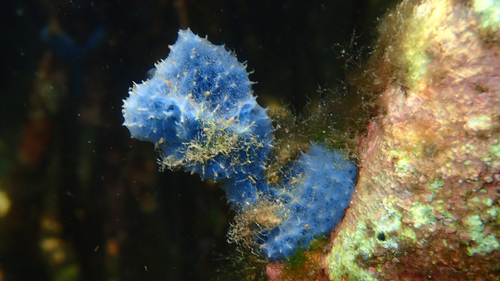
About Dysidea etheria de Laubenfels, 1936
Dysidea etheria is a lobate sponge species with massive, semi-incrusting growth forms. It can be identified by its internal and external light blue coloration, and its exopinacoderm is also observed to be brownish-grey. Its lobes are shaped as elongated, digitated, or lamellar. D. etheria ranges from 10 to 15 centimeters wide and 4 to 7 centimeters tall; its individual lobes have diameters between 2 and 4 centimeters. Its oscula, which measure 5 to 10 millimeters in width, typically sit on the tops of lobes. These oscula have a transparent iris membrane, and their openings are occasionally compound. The sponge’s surface is covered in 1 millimeter high sharp conules spaced 3 millimeters apart. It has a thin exopinacoderm and a fleshy choanosome. Its irregular skeleton is loosely fibroreticular, made of white fibers that contain calcareous debris. This marine species occurs in habitats up to 40 meters deep, primarily in bays and lagoons. It grows on a range of natural and manmade substrates, most of which are hard and vertical. Common manmade substrates include docks, pilings, and the hull of a concrete ship where it was found growing on a scleractinian. Recorded natural substrates are rocks, turtle grass blades, mangrove roots, mollusk and crab shells, coral skeletons, algae, and other sponges. Its known distribution covers the Caribbean, as well as coastal waters off Florida and Georgia. Like all poriferans, D. etheria can use both sexual and asexual reproduction. During sexual reproduction, sponges are hermaphroditic, producing sperm and eggs at different times. D. etheria reproduces asexually via fragmentation; the totipotency of sponge cells lets detached fragments regrow into fully new individual sponges.

