About Dyseriocrania subpurpurella (Haworth, 1828)
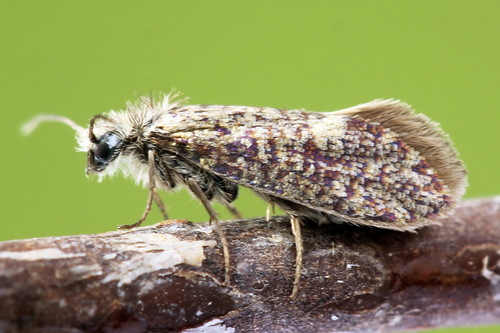
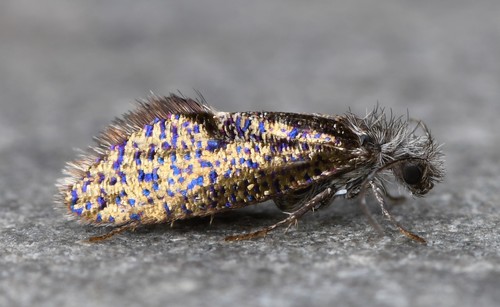
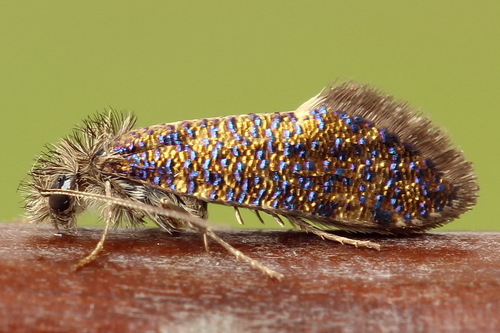
This moth species, Dyseriocrania subpurpurella (Haworth, 1828), has a wingspan ranging from 9 to 14 mm. Its forewings are metallic gold, marked with sapphire-blue and ruby-red dots called strigulae, with an indistinct, faintly paler dorsal spot located just before the tornus. The hindwings are brassy-grey with a purplish tinge on the posterior portion; both forewings and hindwings have grey cilia. The head is a mix of ochreous-grey-whitish and dark fuscous. Adult moths are active in April and May; they fly on sunny days and are attracted to light. On dull days, they rest on the trunks and branches of oak trees, and adults do not feed. A named subspecies, form fastuosella, is more richly marked, with purple spots or striations. Eggs are laid inside the leaf tissue of oak (Quercus) species, roughly 2 mm from the leaf margin. The caterpillar is whitish with a pale brown head. It develops inside leaves of Quercus (oak) species, creating a blotch mine that contains spaghetti-like frass, and feeds from May to July. Initially, the mine is a narrow corridor around 5 mm wide, mostly filled with granular frass. This corridor, or gallery, suddenly widens into a large, full-depth, dirty-whitish blotch that sits along the leaf margin. The frass inside the blotch occurs in long threads. If multiple eggs are laid on the same leaf, their individual mines will merge into one enlarged blotch that holds several larvae. This species' leaf mine is similar to the mine produced by the beetle Orchestes pilosus, but the fully formed beetle mine is smaller and darker. Recorded host plants for the larvae include Turkey oak (Quercus cerris), sessile oak (Quercus petraea), downy oak (Quercus pubescens), Pyrenean oak (Quercus pyrenaica), pedunculate oak (Quercus robur), northern red oak (Quercus rubra), and sweet chestnut (Castanea sativa). When fully developed, the larva spins a tough silken cocoon in the soil; cocoons can be found in the soil from July through to April. Dyseriocrania subpurpurella has been recorded across most European countries, with the exception of Bulgaria, Croatia, Cyprus, the Faroe Islands, Iceland, Malta, and Slovenia.