About Dyseriocrania griseocapitella Walsingham, 1898
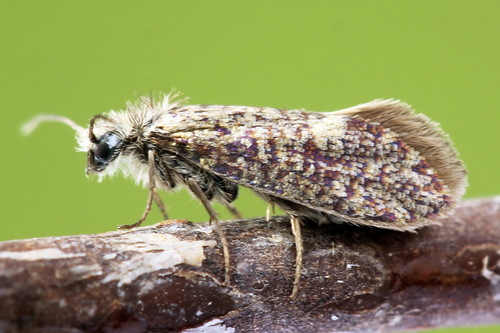
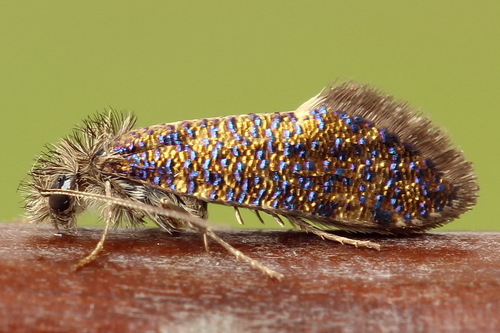
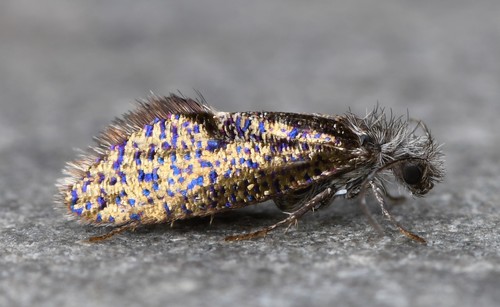
Dyseriocrania griseocapitella, commonly known as the Chinquapin leaf-miner, is a species of moth in the family Eriocraniidae. This moth is distributed from Nova Scotia south to Florida, and westward to Illinois and Mississippi. Males have a wingspan ranging from 10 to 13 mm, while females have a wingspan between 9 and 12.5 mm. The forewings of this moth are golden bronze in color, heavily marked with tiny dark scale specks. The hindwings are paler, with a grayish color and a faint purplish luster, and are sparsely covered with moderately broad scales. D. griseocapitella is active from late February to late May, and produces one generation each year. The larvae feed on plant species belonging to the Castanea and Quercus genera. Larvae create mines inside the leaves of their host plants. The mine begins as a narrow linear passage that extends toward the leaf edge. This early part of the mine is usually destroyed as the mine grows larger. Right after the initial serpentine growth stage, the mine widens into a large, somewhat swollen blotch. When larvae are fully grown, they fall to the ground, burrow into the soil, and spin a relatively tough oval silk cocoon incorporating small soil particles. Full-grown larvae have a dark brown body and a pale brown to light yellow head.