About Dyplolabia afzelii (Ach.) A.Massal.
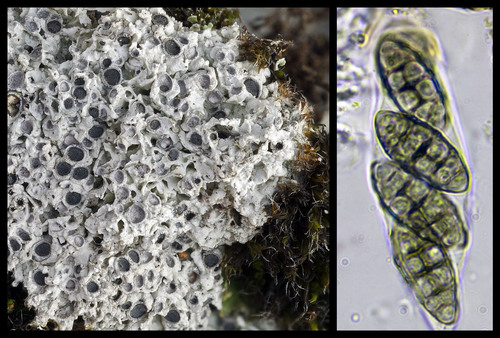
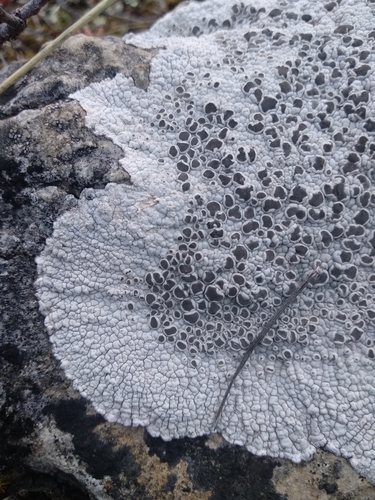
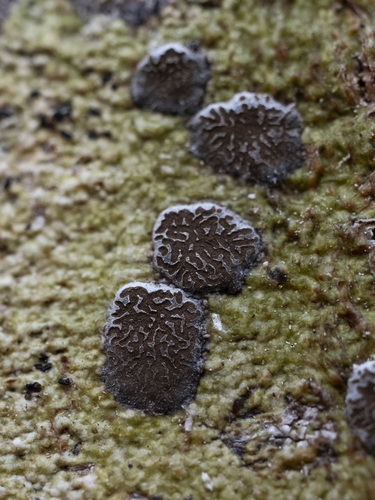
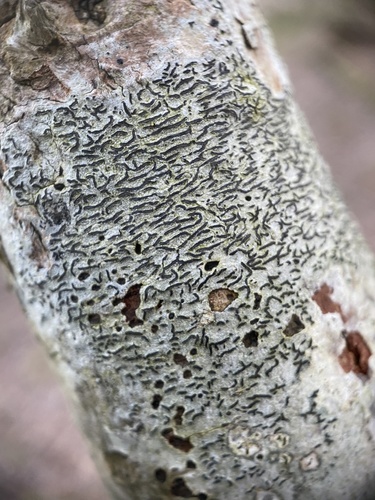
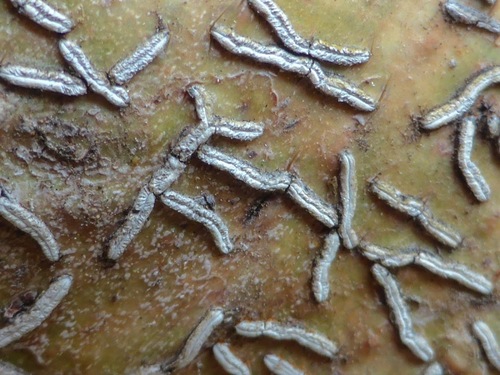
Dyplolabia afzelii is a lichen species formally described with the scientific name Dyplolabia afzelii (Ach.) A.Massal. Abramo Bartolommeo Massalongo transferred this species to the genus Dyplolabia in 1854. This lichen is characterized by a thick, smooth thallus that can be yellow, pale olive buff, dark brownish tan, or grey. Its spore-producing structures, called ascomata, are lirelline, meaning they are elongated with a slit-like opening. The ascomata are 1 to 6 mm long and 0.2 to 0.7 mm wide. Most are simple in form, though they may occasionally be branched or forked. They are raised above the thallus surface, can be straight, curved, or flexuous, and are scattered across the thallus. The ascomata are usually completely hidden under a thick, powdery white pruina layer; their underlying black color is only visible where this layer has worn away. Each ascoma has a blunt end, and its narrow, slit-like disc cannot be seen from the thallus surface. The exciple, the outer tissue layer surrounding the ascoma, is intact at the base, blackened (carbonized) along its sides, and converges at the top. It is wrapped in a thick thalline layer that extends all the way to the ascoma apex. The epithecium, the topmost layer inside the ascoma, is greenish-brown to dark brown, and measures 14–28 μm thick. Inside the ascoma, the filamentous paraphyses are simple, long, thin, and segmented (septate), with thickened ends. The spore-bearing asci are cylindrical, and typically hold eight spores each. The ascospores are ellipsoidal, always have three cross-septations, and measure 14–20 by 6–8 μm. They do not react to iodine staining. Chemically, this species can be identified by the presence of lecanoric acid. Dyplolabia afzelii has been recorded in Australia, Mexico, South America, the Caribbean, India, Thailand, and the Mid-Atlantic Coastal Plain of North Carolina in eastern North America.