About Dynastes tityus (Linnaeus, 1763)
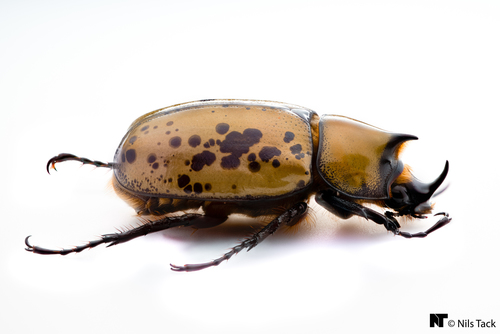
Dynastes tityus, first described by Linnaeus in 1763, has adult body widths of 20 to 27 millimeters (0.8 to 1.1 inches) for both sexes. Males measure 40 to 60 millimeters (1.6 to 2.4 inches) in total length, which includes a long forward-pointing pronotal horn growing from the thorax, plus a second upward-pointing clypeal horn growing from the head. This species counts among the longest and heaviest beetles found in the United States. Rival males use their horns to fight when competing for mates, and horn size reflects how much food was available to the beetle during its growth period. In spite of its large horns, Dynastes tityus is completely harmless to humans. The elytra of this beetle are most commonly green, gray, or tan, and usually marked with black mottling. Every individual has a unique pattern of these dark spots. Beetles found in soil or rotten wood often look very dark, with elytral spots obscured. This darkening happens because the elytra absorb moisture; once the elytra dry out, they return to their original paler color. Moisture is held in the elytra's outer layer, the epicuticle, which alters the reflection angle of light hitting the underlying exocuticle layer, a tissue made of photonic crystals. Rare color variations exist: both elytra may be a solid uniform mahogany color, or one elytron can be pale with dark blotches while the other is plain mahogany. This species was featured on a United States Postal Service stamp issued in October 1999. The genus Dynastes is theorized to have originated in South America. The North American Dynastes lineage evolved after the Isthmus of Panama closed approximately 3.5 million years ago. The Transverse Volcanic Belt and Sierra Madre del Sur later split this lineage into separate eastern and western North American species. D. tityus inhabits the eastern and southeastern United States. Its range extends north to New York, Illinois, and Indiana, south to Florida and the Gulf of Mexico, and west as far as eastern Texas and western Arkansas. The larvae of this eastern Hercules beetle develop in decaying wood, preferring to live and grow in large cavities at or near the bases of trees, and tunnel from these cavities into the soil. Adult D. tityus are found living in vegetation and under moist leaf litter. Fallen leaves and logs protect these beetles from predators. Adults are also found living on ash trees, which help them attract and locate mates.