About Duvaucelia lineata (Alder & Hancock, 1848)
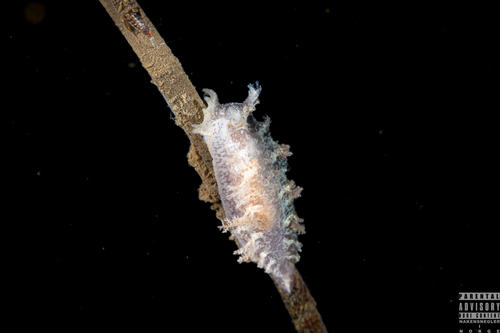
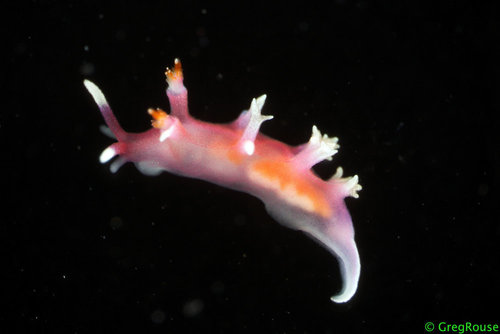
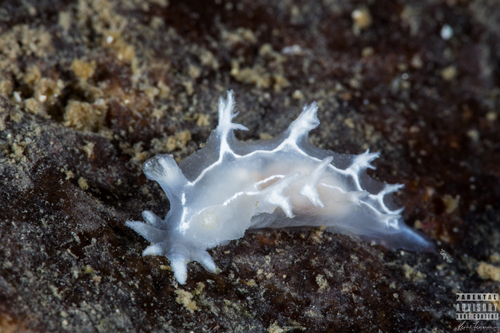
Duvaucelia lineata, with the scientific authority (Alder & Hancock, 1848), was originally discovered in 1846, and formally described in 1848 by British malacologists Joshua Alder and Albany Hancock. The original type description reads: Body very slender, pellucid white, with an opake white line along each side of the back, which is curved a little outwards opposite each branchial tuft. Veil produced into four long filaments; the two nearest the centre longest and tapering gradually to a point, the side ones shorter and obtuse. Tentacles pale yellow, the fascicules of filaments slender, and the sheaths rather tight. Branchiae rather slender, bipinnate, transparent, with an opake white line in the centre of each running into those on the back. Foot slender, rounded in front and terminating in a point behind. Length half an inch. This beautiful new Tritonia was discovered under stones at Scarborough in September 1846, while we were exploring the rocks in company with Mr. Bean. The type locality of this species is Scarborough, North Yorkshire, England. Duvaucelia lineata occurs at scattered localities along the coasts of Great Britain and Ireland, southern Norway, and Brittany, France. It has also been reported from the Adriatic Sea in Croatia.