About Duranta erecta L.
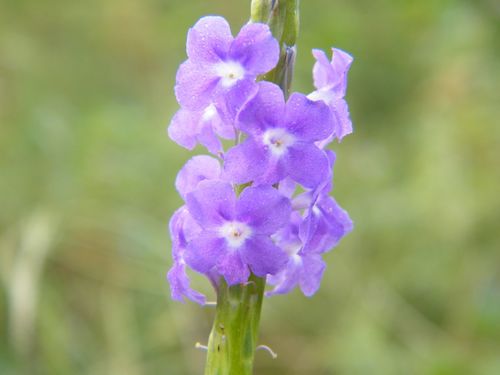
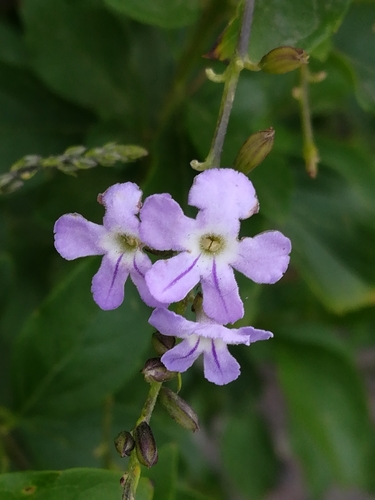
Duranta erecta L. is most often a sprawling shrub, and rarely grows as a small tree. It can reach 6 meters (20 feet) in height, and spreads to an equal width. Mature plants grow axillary thorns, which are typically absent on younger specimens. Its leaves are light green, elliptic to ovate, arranged oppositely, and grow up to 7.5 cm (3.0 in) long and 3.5 cm (1.4 in) wide, attached by a 1.5 cm petiole. The flowers are light-blue or lavender, borne in tight clusters on terminal and axillary stems. These clusters sometimes form panicles, and are often recurved or pendulous; this species blooms in summer. Its fruit is a small globose yellow or orange berry, measuring up to 11 mm (0.43 in) in diameter and holding several seeds. Duranta erecta is native to the Americas, ranging from Mexico and the Caribbean south to Brazil and Argentina. There is ongoing debate over whether it is also native to the southern United States (Florida, Louisiana, Texas, Arizona, and California), or if it is an introduced species in those areas. It grows at altitudes between 40 and 1100 meters above sea level. In its native range, it commonly grows in rocky or sandy coastal areas with full sun, or in moister, disturbed inland sites. Before it reaches maturity, this plant can grow up to half a meter per year. Golden dewdrop (the common name for this species) is widely cultivated as an ornamental plant across tropical and warm subtropical regions. Its showy flowers and fruit make it a popular garden plant, and its blossoms attract butterflies and hummingbirds. Many cultivars are available, including 'Alba', 'Aurea', 'Aussie Gold', 'Gold Mound', 'Geisha Girl', 'Sapphire Showers', and 'Variegata'.