About Dundubia vaginata (Fabricius, 1787)
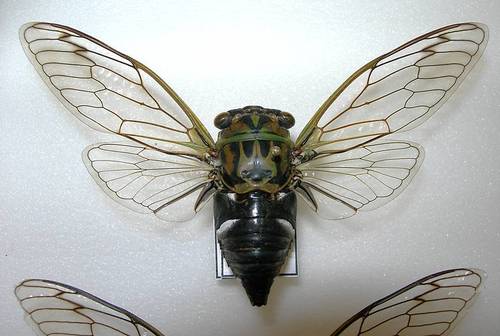
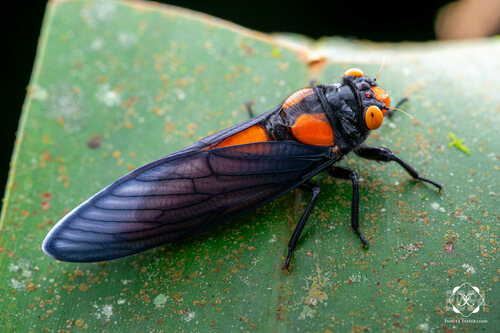
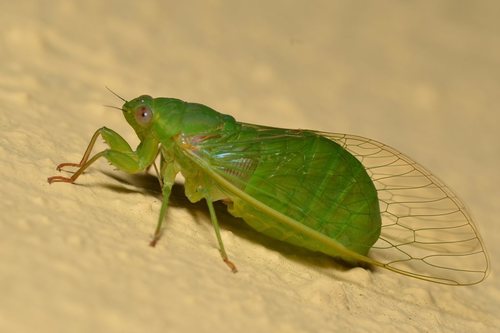
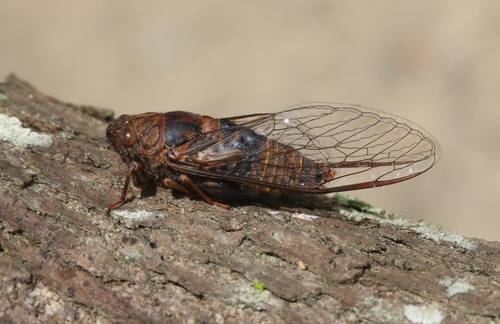
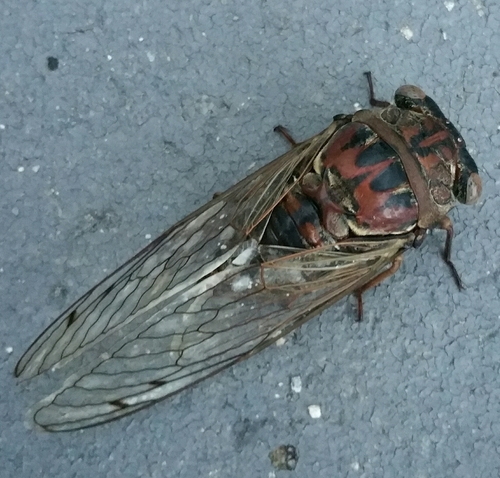
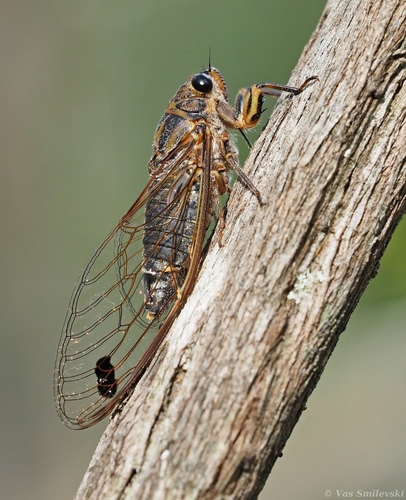
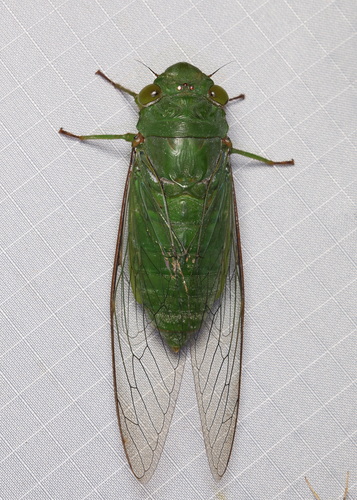
Dundubia vaginata (Fabricius, 1787) is a cicada species that can have an entirely uniform jade green body and transparent wings. Its overall body coloration is highly variable; the head, thorax, and abdomen can range from ochre to brown to green. Both pairs of wings are hyaline, and may carry a slight bronze tinge. Males range in length from 35 to 45 mm, while females range from 30 to 39 mm. The front of the head is never black. The upper part of the clypeus is twice as wide at its base as the anterior lateral margins of the vertex. The rostrum extends past the intermediate coxa, barely reaching the posterior coxa, and its apex is black.
In males, the opercula are spoon-shaped rather than laterally curved, with a rounded end. They are twice as long as they are wide, and are not strongly constricted. These opercula cover the tymbals, and extend to the fifth to seventh abdominal segment. The mesonotum may sometimes bear black lines, and the head, thorax, and abdomen are ochre or bright green. The uncus is made up of two broad, obtuse lobes, and the abdomen is uniformly colored with no black spots.
In females, the opercula lack a lateral tooth, and the mesonotum has no black lines. The base of the abdomen is fairly pointed and slightly curved upwards, and the lateral sides of the abdomen have no black spots.
Dundubia vaginata is one of the most widespread species in the genus Dundubia, and is typically found in tropical forests. Its recorded distribution spans widely across Southeast Asia, ranging from India and China to Japan, Thailand, and Malaysia, and extending through to Sulawesi and northern Australia.
The life cycle of Dundubia vaginata ends with the emergence of the adult imago, which has a periodic life cycle and lives for one to two months. Known predators of adult imagos are bats and Dicrurus paradiseus, while caecilians may feed on the species' larvae.