About Duma florulenta (Meisn.) T.M.Schust.
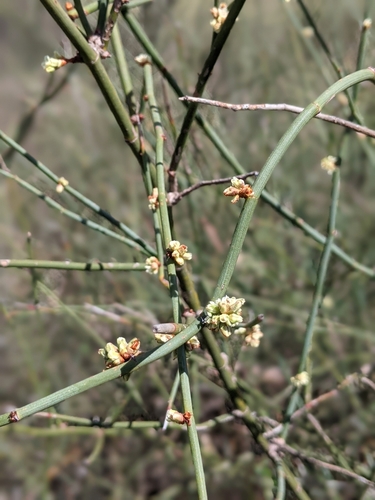
Duma florulenta, commonly known as lignum, is a perennial dioecious shrub that grows up to 2.5 m tall. It produces a great number of thin, intertwined, tangled branches and branchlets that form dense thickets that exclude other plant species. Its thin, narrow leaves measure 15–70 mm long and 2–10 mm wide. Grey-green stems often end in a sharp point. Flowers are small, range in color from cream to yellowish, and grow either solitary or clustered along branchlets, blooming through most of the year. The fruit is dry, top-shaped, and approximately 5 mm long. Lignum often appears leafless: leaves grow on new young growth, but die off quickly, especially during dry conditions. It produces new leaves and shoots very rapidly in response to rainfall or flooding. This species has an extremely deep root system that penetrates at least 3 m into the soil. It is highly tolerant of both salinity and drought, and can be used as an indicator of dryland soil salinity. Due to its densely tangled growth habit, it provides protected breeding habitat for native wildlife such as waterbirds. However, it can also act as refuge for pest species including feral pigs, foxes, and rabbits. Lignum is found across all mainland Australian states and the Northern Territory. It prefers habitats including floodplains, swamps, gilgais, and other areas that flood intermittently. In southern Australia, it is commonly associated with stands of river red gum and black box. During the Stolen Generations, the long period when the Australian government forcibly removed children from their Aboriginal parents, Walmajarri people hid themselves and their children within the dense tangled branches of lignum to avoid detection by police.