About Dulichium arundinaceum (L.) Britton
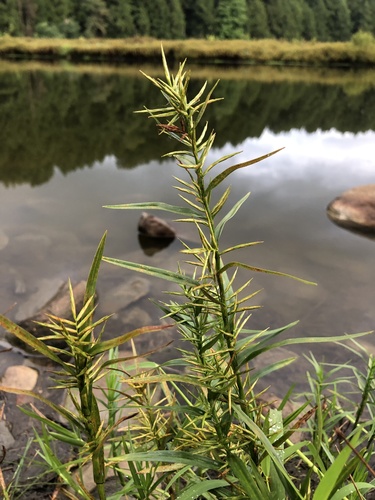
Dulichium is a monotypic genus in the sedge family that contains only one species: Dulichium arundinaceum (L.) Britton, commonly known as threeway sedge. Threeway sedge is an aquatic or semi-aquatic plant that grows in lakes, streams, and ponds across the United States and Canada. It has a wide distribution throughout both countries, but it is noticeably absent from the Dakotas and the Southwestern Deserts. This species has a thick rhizome system and grows to heights close to one meter. When new, its appearance is reminiscent of bamboo, growing bright green erect stalks in large, grassy stands. Stems are round to slightly triangular in cross-section, far less sharply triangular than stems of Cyperus or Carex, and they are hollow. When viewed from above, leaves grow in three distinct ranks along the stem – this arrangement gives the plant its common name threeway sedge. Leaves have sheaths that run along the stems, and the inflorescence grows from the leaf axilla. Ripe spikelets are generally lance-shaped and measure one to three centimeters long. Two varieties of Dulichium arundinaceum are currently recognized. Dulichium arundinaceum var. arundinaceum occurs across most of the species' range, including Québec. Dulichium arundinaceum var. boreale Lepage is found in Québec.