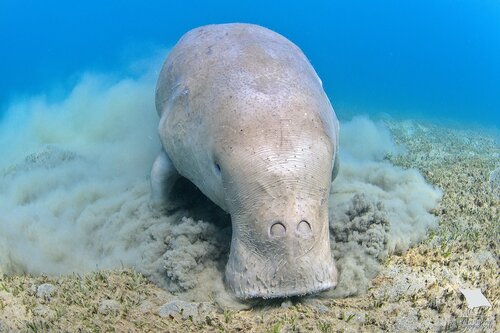
About Dugong dugon (Müller, 1776)
Anatomy and morphology: The dugong (Dugong dugon) has a large, cylindrical body that tapers at both ends. Its skin is thick and smooth, starting as pale cream at birth and darkening to brownish-to-dark-grey on the dorsal and lateral sides as the animal ages. Skin color can also change from algae growing on its surface. Adult dugong length rarely exceeds 3 metres (10 ft), and an individual of this length typically weighs around 420 kilograms (930 lb). Adult weight generally ranges between more than 250 kilograms (550 lb) and less than 900 kilograms (1,980 lb). The largest recorded individual measured 4.06 metres (13 ft 4 in) long and weighed 1,016 kilograms (2,240 lb), and was found off the Saurashtra coast of west India. Females tend to be larger than males. The dugong's body is sparsely covered in short hair, a trait common among sirenians that may allow tactile interpretation of the environment. These hairs are most developed around the mouth, which has a large horseshoe-shaped upper lip forming a highly mobile muzzle. This muscular upper lip helps the dugong forage. Dugong tail flukes and flippers resemble those of dolphins. Flukes are moved up and down in long strokes to propel the animal forward, and can be twisted to turn. The forelimbs form paddle-like flippers that aid in turning and slowing. Dugongs lack nails on their flippers, which make up only 15% of the animal's total body length. The tail has deep notches. A dugong's brain reaches a maximum weight of 300 g (11 oz), equal to roughly 0.1% of the animal's total body weight. Dugongs have very small eyes and limited vision, but have acute hearing within narrow sound thresholds. Their ears, which lack pinnae, sit on the sides of the head. The nostrils are located on top of the head and can be closed using valves. Dugongs have two teats, one positioned behind each flipper. There are few physical differences between the sexes; their overall body structures are nearly identical. Males have internal testes, and the main difference between males and females is the location of the genital aperture relative to the umbilicus and anus. Dugong lungs are very long, extending almost as far as the kidneys, which are also highly elongated to adapt to the saltwater environment. If a dugong is wounded, its blood clots rapidly. The dugong's skull is unique: it is enlarged with a sharply down-turned premaxilla, which is stronger in males than in females. The spine contains between 57 and 60 vertebrae. Unlike manatees, dugong teeth do not continually regrow via horizontal tooth replacement. Dugongs have two incisor tusks that emerge in males during puberty. Female tusks continue growing without emerging during puberty, and sometimes erupt later in life after reaching the base of the premaxilla. The number of growth layer groups in a tusk indicates the dugong's age, and the cheek teeth move forward as the animal ages. The full dugong dental formula is 2.0.3.3/3.1.3.3, meaning there are two incisors, three premolars, and three molars on each side of the upper jaw, and three incisors, one canine, three premolars, and three molars on each side of the lower jaw. Like other sirenians, dugongs have pachyostosis: a condition where the ribs and other long bones are unusually solid and contain little to no marrow. These heavy bones, among the densest in the animal kingdom, may act as a ballast to help keep dugongs suspended slightly below the water's surface. Distribution and habitat: Dugongs inhabit warm coastal waters from the western Pacific Ocean to the eastern coast of Africa, along an estimated 140,000 kilometres (87,000 mi) of coastline between 26° and 27° north and south of the equator. Their historic range is believed to match the range of seagrasses from the Potamogetonaceae and Hydrocharitaceae families. The full size of their former range is unknown, but current populations are thought to fall within the historical range limits, which are now highly fractured. During warmer Holocene periods, their distribution may have been broader than it is today. Today, dugong populations are found in the waters of 37 countries and territories. Recorded dugong counts are generally believed to be lower than actual population numbers, due to a lack of accurate surveys. Despite this uncertainty, the global dugong population is thought to be shrinking, with a 20 percent worldwide decline over the last 90 years. Dugongs have disappeared from the waters of Hong Kong, Mauritius, and Taiwan, as well as parts of Cambodia, Japan, the Philippines, and Vietnam. Further local disappearances are likely. Dugongs are generally found in warm coastal waters, with large populations concentrated in wide, shallow protected bays. The dugong is the only strictly marine herbivorous mammal, as all manatee species use fresh water to some degree. However, dugongs can tolerate the brackish water of coastal wetlands, and large numbers also live in wide, shallow mangrove channels and around the leeward sides of large inshore islands, where seagrass beds are common. They usually stay at a depth of around 10 m (33 ft), but in areas where the continental shelf remains shallow, dugongs have been recorded traveling more than ten kilometres (6 mi) from shore, descending as far as 37 metres (121 ft) to access deepwater seagrasses such as Halophila spinulosa. Dugongs use different specific habitats for different activities: shallow waters are used as calving sites to minimize predation risk, while deep waters may provide a thermal refuge from cooler nearshore waters during winter. Ecology and life history: Dugongs are long-lived, and the oldest recorded specimen lived to age 73. They have few natural predators, though crocodiles, killer whales, and sharks pose a threat to young dugongs. One dugong has been recorded dying from trauma after being impaled by a stingray barb. Many infections and parasitic diseases affect dugongs; detected pathogens include helminths, cryptosporidium, multiple types of bacterial infections, and other unidentified parasites. 30% of dugong deaths in Queensland since 1996 are thought to be caused by disease. Although dugongs are social animals, they are usually solitary or found in pairs, because seagrass beds cannot support large populations. Gatherings of hundreds of dugongs occasionally occur, but only last for a short time. Because they are shy and do not approach humans, little is known about dugong behavior. They can go six minutes without breathing, though two and a half minutes is more typical, and they have been observed resting on their tails to breathe with their heads above water. They can dive to a maximum depth of 39 metres (128 ft), but spend most of their lives no deeper than 10 metres (33 ft). Individuals communicate through chirps, whistles, barks, and other sounds that echo underwater. Different sounds have different amplitudes and frequencies, suggesting they serve different purposes. Visual communication is limited due to poor eyesight, and is mainly used for activities like lekking during courtship. Mothers and calves stay in almost constant physical contact, and calves have been observed touching their mothers with their flippers for reassurance. Dugongs are semi-nomadic: they often travel long distances searching for food, but stay within a fixed range their entire lives. Large groups often move together from one area to another, and these movements are thought to be caused by changes in seagrass availability. Their memory allows them to return to specific points after long travels. Most dugong movements happen within a localized area of seagrass beds, and animals in the same region have individual movement patterns. Daily movement is affected by tides: in areas with a large tidal range, dugongs travel with the tide to access shallower feeding areas. In Moreton Bay, dugongs often travel between foraging grounds inside the bay and warmer oceanic waters. At higher latitudes, dugongs make seasonal trips to reach warmer water during winter. Occasionally, individual dugongs make long-distance travels over many days, and can cross deep ocean waters; one individual was seen as far south as Sydney. Though they are marine animals, dugongs have been known to travel up creeks; one individual was caught fifteen kilometres (8 nmi) up a creek near Cooktown. Reproduction and parental care: A dugong reaches sexual maturity between eight and eighteen years of age, older than most other mammals. Females can identify sexually mature males by the eruption of their tusks, as tusks erupt in males when testosterone levels reach a high enough threshold. The age when a female first gives birth is disputed: some studies place the age between ten and seventeen years, while others place it as early as six years. There is evidence that male dugongs lose fertility at older ages. Despite the dugong's longevity, with many individuals living 50 years or more, females give birth only a few times during their lives, and invest extensive parental care in their young. The interval between births is unclear, with estimates ranging from 2.4 to 7 years. Mating behavior varies between populations in different areas. In some populations, males establish territories that females in estrus visit. In these areas, males attempt to impress females while defending their territory from other males, a practice called lekking. In other areas, many males attempt to mate with the same female, sometimes injuring the female or each other. During these events, the female copulates with multiple males, who fight to mount her from below, which greatly increases the chance of conception. Females give birth after a 13- to 15-month gestation, usually to just one calf. Birth takes place in very shallow water, and there are recorded cases where mothers were almost on shore. Immediately after birth, the mother pushes the calf to the surface to take its first breath. Newborn dugongs are already 1.2 metres (4 ft) long and weigh around 30 kilograms (65 lb). After birth, calves stay close to their mothers, possibly to make swimming easier. Calves nurse for 14–18 months, though they begin eating seagrasses soon after birth. A calf only leaves its mother once it has matured.

