About Dugesia gonocephala (Duges, 1830)
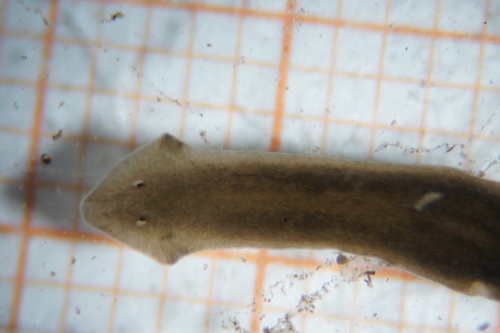
Dugesia species have elongated bodies with slightly triangular heads. Their dorsal surface is most often grey, brown, or black, while the ventral surface is typically paler. These animals have two eyes, each formed by a multicellular pigmented cup with many retinal cells that detect the amount of light in the nearby environment. Supernumerary eyes may sometimes occur. At the anterior portion of the body, behind the level of the eyes, there is a pair of structures called auricles. Auricles give the head its triangular shape and allow the animal to detect water current intensity; these structures are free of both pigment and rhabdites. Each side of the anterior head margin holds between 5 and 10 shallow sensory fossae, with number varying by species and individual. Both the sensory fossae and auricle grooves are supplied with many nerve endings. The Dugesia digestive system includes a central, non-pigmented tubular pharynx. Like other triclads, Dugesia has a gut made of three branches: one anterior branch and two posterior branches. Each branch contains caeca that deliver nutrients to the body, and the gut does not have a separate opening for waste excretion. The subepidermal musculature of Dugesia is divided into four layers. In Dugesia, the ovaries are located ventrally, starting just behind the brain, usually at the level of the fourth intestinal branch. The bursal canal runs along the right side of the copulatory apparatus and above the atrium. Like some Neppia species, Dugesia species have a third layer of longitudinal musculature over the vaginal area of the bursal canal, a feature that does not occur in other triclads. Another feature shared with Neppia is a glandular area at the transition between the seminal vesicle and the ejaculatory duct; in Dugesia, these glands are concentrated at the diaphragm, a structure that does not exist in any other genera. Ball proposed that the presence of these glands is a synapomorphy of Dugesia and Neppia, and the absence of these glands in the Neppia species N. jeanneli, N. montana, and N. schubarti is thought to be a secondary loss. Dugesia species are hermaphrodites. Many Dugesia species can reproduce both sexually and asexually, through either parthenogenesis or fission.

