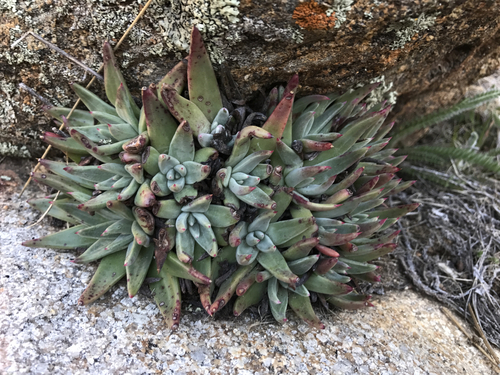
About Dudleya pauciflora Rose
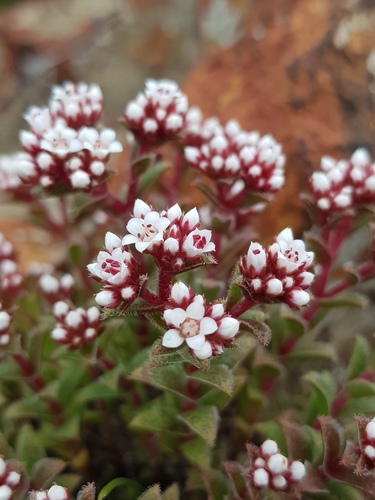
Dudleya pauciflora Rose is a rosette-forming succulent plant that grows in clumps via dichotomous branching. Key identifying traits include small, crowded rosettes, a colorful inflorescence with long pedicels, and small yellow flowers marked with red. Compared to other species in the Dudleya genus, its clustered rosettes resemble those of Dudleya abramsii, while its reddish flowers and inflorescence resemble those of Dudleya nubigena. Both Reid Moran and Joseph Nelson Rose suggested a possible relationship between D. pauciflora and D. nubigena. The caudex of D. pauciflora is short, 0.7–2.5 cm (0.28–0.98 in) thick, and densely covered by persistent dried leaves. It branches in a caespitose pattern, forming clumps of rosettes up to 3 dm (12 in) wide that can contain up to 100 individual rosettes. On plants with densely crowded rosettes, leaves grow erect to ascending; on plants with fewer rosettes, leaves are more spreading. Leaves may range from green to farinose, and are shaped triangular-lanceolate with a narrowly acute, apiculate tip. They measure 2–5 cm (0.79–1.97 in) long and 2–5 mm (0.079–0.197 in) thick. Floral stems emerge in summer; the peduncle is 2–5 mm (0.079–0.197 in) thick, red, and glaucous. The lower portions of the stems are leafless, while the upper portions bear 8 to 30 ascending, triangular-lanceolate bracts. The lowermost bracts measure 1–3 cm (0.39–1.18 in) long. The cyme is made up of 2 to 3 simple or bifurcate branches. Terminal branches are circinate, unfurling like a fern frond, and become nearly erect as they age. Each terminal branch holds 2 to 16 flowers, which open at intervals of 2 to 5 days. The pedicels are red, mostly erect, initially ascending, and rarely pendent; the first pedicel on a branch is usually 7–20 mm (0.28–0.79 in) long. Flowering mostly occurs from July to September. Flowers usually have 5 parts each. The red calyx is 3–5 mm (0.12–0.20 in) long, with deltoid segments. The corolla is pentagonal, 6–10 mm (0.24–0.39 in) long. Petals are yellow on the inside, with red-flushed keels that give the corolla an orange or reddish overall appearance. Petals are oblong in shape with acute tips, and measure 1.5–3 mm (0.059–0.118 in) wide. Dudleya pauciflora grows at high elevations in the Sierra San Pedro Mártir and Sierra de San Borja, located in Baja California. Its occurrences range from 1,250 m (4,100 ft) up to the peak of Sierra San Pedro Mártir, Picacho del Diablo, at 3,025 m (9,925 ft). 240 km (150 mi) south-southeast of this range, in Sierra de San Borja, the species is found on the range’s highest peak, Cerro la Sandia.