About Dudleya palmeri (S.Watson) Britton & Rose
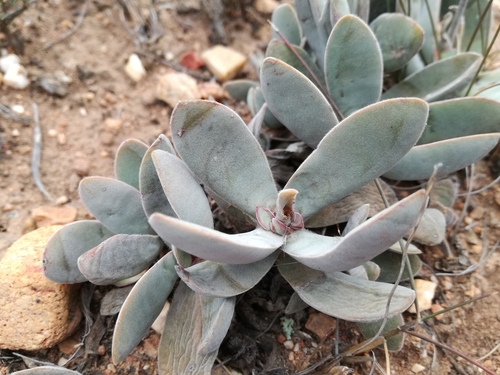
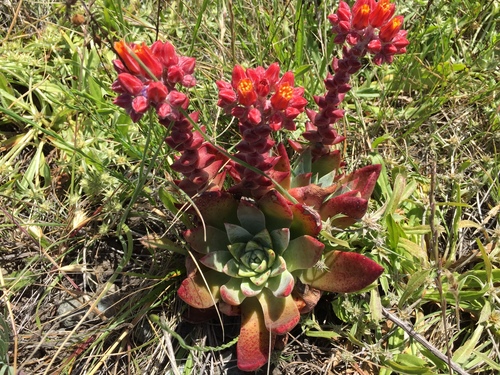
Vegetative morphology: Dudleya palmeri may grow as solitary plants or in caespitose clumps of up to 8 rosettes. Each rosette ranges from 5 to 55 cm wide. In older individuals, the stem is usually covered by dried, desiccated leaves. The leaves of this species measure 5 to 20 cm long, 1.5 to 5 cm wide, and 3 to 8 mm thick, with a shape ranging from lance-oblong to lanceolate. The upper leaf surface is either flat or transversely convex, and leaves may or may not be covered in epicuticular wax. When leaves are removed from the plant, the remaining leaf bases at the wound site turn red. Leaf tips are acute to acuminate, and leaf margins are often angled between the upper and lower leaf surfaces. Reproductive morphology: The inflorescence grows on a peduncle that is 15 to 85 cm tall and 4 to 11 mm wide. The inflorescence branches around 3 times, and may branch an additional 2 times after that. The terminal branches are 5 to 8 cm long, and each bears 5 to 14 flowers. Flowers are held on erect pedicels 2 to 10 mm long. The flower sepals are 3 to 5 mm long, shaped deltate to ovate, with an acute tip. Petals measure 11 to 16 mm long and 3 to 5 mm wide, are elliptic in shape, and come in colorations including red over yellow, bright yellow marked with red, and orange. Petal tips are erect and acute. The recorded chromosome numbers for this species are 2n = 136, 170, 238. Flowering occurs in late spring, most typically from May to July. Distribution and habitat: This species is found along the California coast, from the Santa Lucia Mountains in Monterey County south to the Santa Monica Mountains in Los Angeles County. It grows on rocky slopes and cliffs near the coast, at elevations from 0 to 100 meters.