About Dudleya nubigena (Brandegee) Britton & Rose
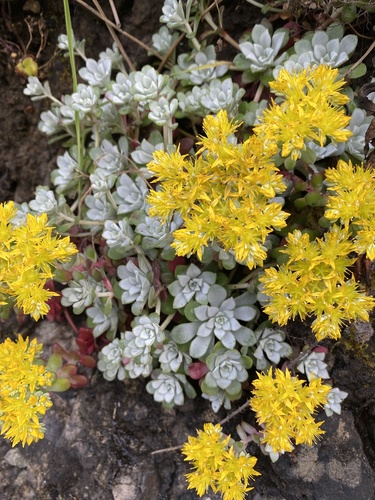
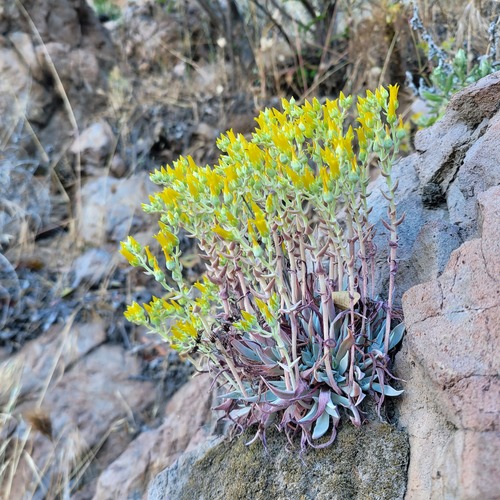
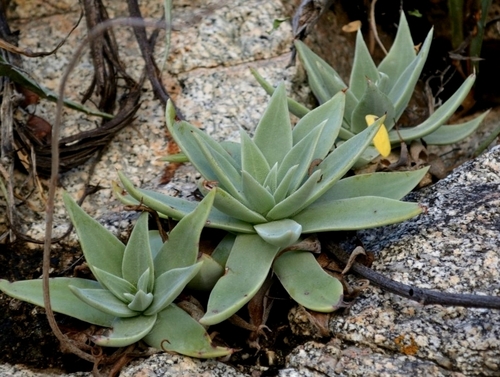
Dudleya nubigena (Brandegee) Britton & Rose has vegetative characteristics as follows: the caudex grows up to 7 cm high, and is typically unbranched, unless growing in montane areas. Rosettes are mostly solitary, 4 to 18 cm wide, and bear 10 to 22 crowded leaves, though cultivated plants may have up to 30 leaves. Rosette leaves are typically farinose, but may sometimes appear green. Leaf shape ranges from triangular-lanceolate to oblong-obovate, with leaf apexes acute to acuminate, and often apiculate. Leaves measure 3 to 10 cm long, 1.5 to 3 cm wide, and 2 to 4 mm thick, with a mostly flat shape and ventral channeling. Leaf bases are 1 to 2 cm wide; leaf margins are acute near the base, and obtuse to rounded above. For reproductive characteristics: the peduncle grows 10 to 30 cm tall from the base to the cyme, and measures 1.5 to 5 mm thick. It is colored pink to red, often glaucous, and has variable shape depending on the subspecies. The lower 2 to 12 cm of the peduncle is bare; above this bare section, the peduncle has 5 to 23 ascending bracts shaped triangular-ovate to triangular-lanceolate. Lower bracts measure 4 to 30 mm long and 3 to 12 mm wide. The cyme is commonly pinkish and glaucous, composed of 2 to 3 branches that may bifurcate up to two times. The cincinni bear 4 to 24 flowers; in cultivated plants, flowers open at intervals of 2 to 5 days, and each flower stays open for 5 to 6 days. Pedicels are pinkish, with variable characteristics depending on subspecies. They measure 8 to 25 mm long, growing up to 40 mm long in cultivation. Pedicels are 1 to 1.5 mm thick at their base, and thicken toward the upper end. Plants flower from December through April; during anthesis and when fruiting, pedicels become more or less erect. The calyx is green to red, 3 to 6 mm long, 4 to 6 mm wide, and sub-truncate to rounded at its base. The calyx disk measures 4 to 5 mm wide. Calyx sinuses may sometimes be U-shaped at anthesis, and are otherwise V-shaped to closed. Calyx segments are deltoid and acute, measuring 2 to 5 mm long and 2 to 3.5 mm wide. The segments are usually erect or ascending at anthesis, with their tips 0.5 to 2 mm away from the corolla. The tips usually become appressed after anthesis, but may already be appressed at anthesis in montane forms. The corolla is pyramidal with nearly flat sides, 7 to 10 mm long, and elongates by 1 to 1.5 mm during anthesis. It is 4 to 6 mm wide at the base, often wider than the calyx disk, and 2.5 to 4 mm wide at the apex. It is colored yellow to mostly orange or coral red, with glaucous keels. The corolla tube is 2.5 to 5.5 mm long. Corolla segments are oblong, obtuse to broadly acute, and 1.5 to 2.5 mm wide. Filaments are not perfectly cylindrical in cross section, light yellow, 5 to 8 mm long measured from the base of the corolla, and adnate 2 to 4 mm. Anthers are oblong-lanceolate, 1.5 to 2 mm long, 0.6 to 0.7 mm wide, and light yellow. Nectar glands are white, around 0.25 mm high, 1 to 1.5 mm wide, and 0.3 to 0.5 mm thick radially. The gynoecium is 5 to 9 mm high, 2.5 to 3 mm thick, with erect, appressed pistils that are connate up to around 0.5 to 1.0 mm. The gynoecium is greenish, with oblong ovaries that taper rather abruptly to yellowish or reddish styles 1 to 1.5 mm long. Plants produce 50 to 110 ovules, each around 0.5 mm long and 0.2 mm thick. Seeds are brown, narrowly ovoid, acute, longitudinally striated, and roughly 0.5 to 0.7 mm long. The chromosome count for this species is n=17. In terms of distribution and habitat, the main species occurs throughout the Cape region of Baja California Sur, both along the coast and in the Sierra de la Laguna and the Sierra de las Cacachilas. It is also found in the far southern end of the Sierra de la Giganta at Cerro Mechudo, and on Isla Espíritu Santo. Subspecies cerralvensis is very rare, and is only known from a few populations in cool canyons on Cerralvo Island.