About Dudleya formosa Moran
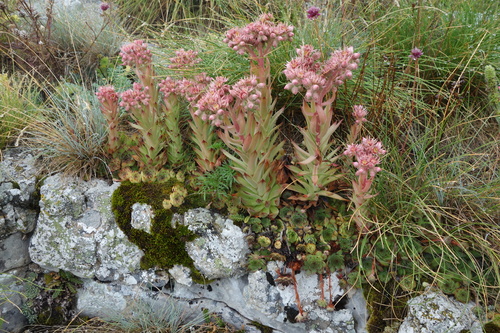
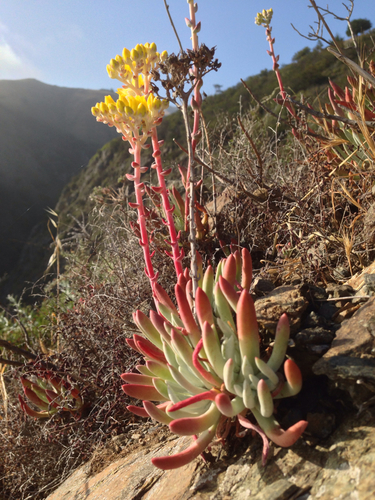
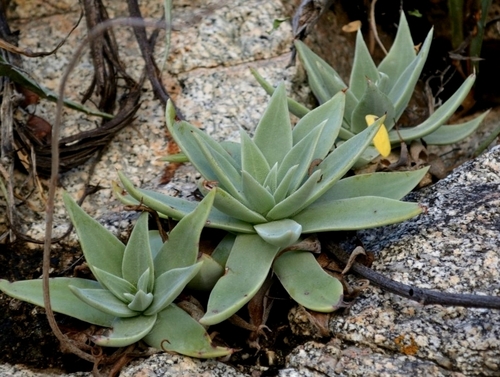
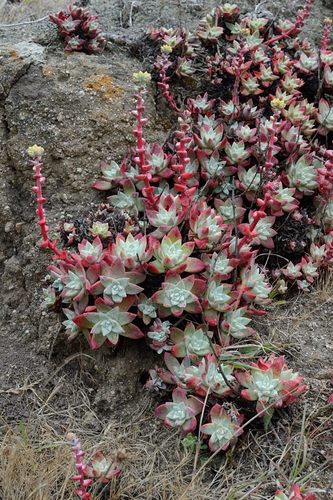
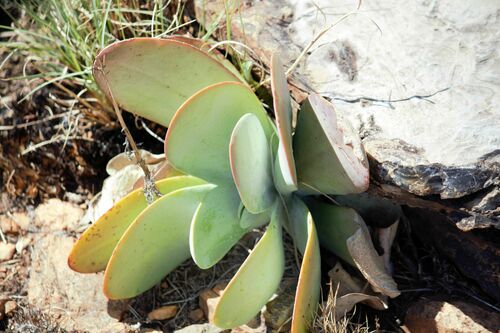
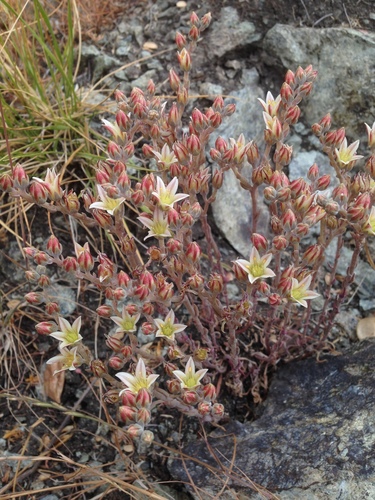
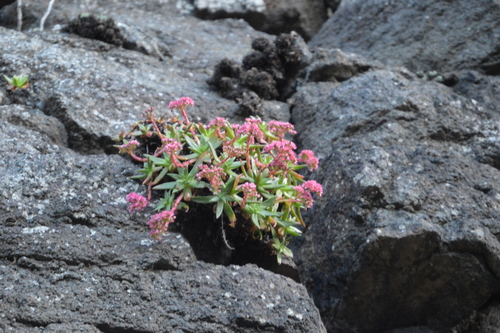
Dudleya formosa Moran has a trailing caudex that is 0.5 to 2.5 cm thick, grows to over 5 decimeters long, and branches to form a loose, prostrate mound that can contain up to several hundred rosettes. Its rosettes are flattish, 4 to 13 cm in diameter, and hold around 10 to 20 leaves each. Leaves are oblong to oblong-obovate, with an acute to obtuse shape ending in a sharp 0.5 mm long tip. Foliage is bright green, and like other Dudleya species, leaf tips and margins carry a red tinge. Leaves are not glaucous, measuring 2 to 8 cm long, 1 to 3 cm wide, and 3 to 6 mm thick. Leaves are convex ventrally (on the lower surface) and flat dorsally (on the upper surface), with subacute leaf margins. The leaf base is 10 to 20 mm wide and 1 to 4 mm high; rarely, on rapidly growing stems, the base is decurrent and up to 10 mm high. The peduncle is red, 4 to 15 cm high, and 3 to 6 mm thick, with foliage covering 2 to 5 cm of its base. It bears 10 to 17 close-set, horizontal bracts that are ovate to triangular lanceolate, cordate, and acute; the lowermost bracts are 8 to 21 mm long and 4 to 12 mm wide. The inflorescence has a pink hue, is quite dense, and has a somewhat flat-topped to hemispherical shape. It measures 2 to 6 cm in diameter, and typically has 3 to 7 close-set branches that rebranch once or twice. The cincinni can be spreading or ascending, grow up to 2 cm long, and hold 2 to 6 flowers each. Pedicels are erect and stout; the lowermost pedicels are 1 to 3 mm long and 2 to 2.5 mm thick. The flower's calyx is rounded below, 4 to 5 mm wide and 2 to 3 mm high, with triangular, acute sepals that are 1 to 2 mm long and 2 to 3 mm wide. The sinuses (cavities between sepals) are broad and rounded. Petals are white with a pink tinge, or may have a bright red keel. Petals are elliptic, acute, 8 to 9 mm long and 3 to 4 mm wide, expanding laterally from just below the middle, and are 1 to 1.5 mm connate. Inside the flower, filaments are 5 to 6.5 mm long and adnate; epipetalous stamens are slightly shorter than antesepalous stamens. Anthers are red, and carpels are 6 to 7 mm high, with thin styles 2 to 2.5 mm long. Seeds of D. formosa are brown, ovoid, 1 mm long, and covered in longitudinal striations, which is a characteristic of the Dudleya genus. D. formosa is distinguished from other members of its clade by its short, broad rosette leaves. Its dense inflorescence, stout pedicels, and pink, spreading petals further set it apart as a unique species. Dudleya formosa occurs in the Guadalupe Valley in far northwestern Baja California, specifically in the area around the town of La Misión. It grows on north-facing cliffs made of basaltic rock.