About Dudleya farinosa (Lindl.) Britton & Rose
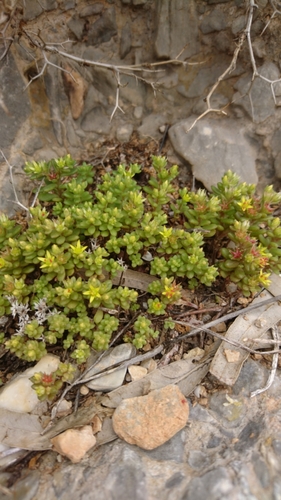
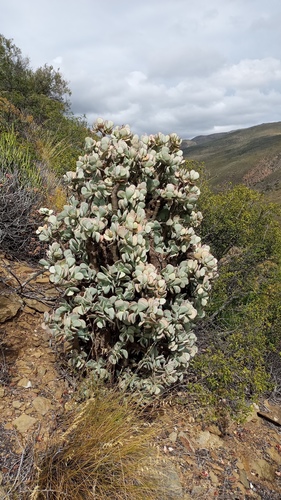
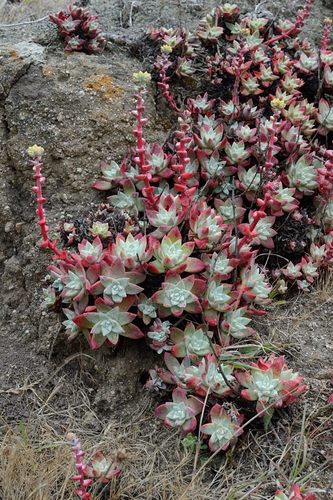
Dudleya farinosa (Lindl.) Britton & Rose produces rosettes that grow from thick, woody succulent stems called caudices. Since this species typically roots on vertical bluffs and cliffs, mature caudices become decumbent or pendent, hanging downward from their growing point. The rosette, a circular arrangement of vegetative leaves, forms at the tip of the caudex. During the dormant season, older outer leaves of the rosette dry out and are pushed backward as the rosette and stem grow forward. This leaves the stem covered in many dried dead leaves, which distinguishes D. farinosa from Dudleya caespitosa, which has relatively leafless stems. Plants of this species usually have multiple rosettes and multiple stems, which develop from a single plant through dichotomous branching. The primary rosette divides at its center, and the two growing points gradually separate until two branches with their own rosettes form. This process repeats continuously, forming clumps ranging from as few as 4 rosettes to large mats of up to 60 rosettes on a single plant; this species does not grow axillary branches. As a leaf succulent, D. farinosa forms rosettes of short, thick, pointed leaves that are sometimes heavily covered in farina, also called epicuticular wax, which protects the plant from sun exposure and helps retain water. One form of D. farinosa lacks this white wax, with green, glossy foliage instead. Stress, cool wind, sunshine, and exposure can cause the edges or tips of the leaves to turn red, maroon, or violet. For sexual reproduction, the plant grows a tall stalk called a peduncle before summer, which bears the inflorescence. The peduncle is covered in 20 to 35 leaves called bracts, which match the color of the rosette’s vegetative leaves. When the structure matures, the stalk divides into 3 to 5 branches, which may sometimes divide again, to hold the flowers, creating an overall flat-topped inflorescence at the top of the peduncle. The pale yellow flowers attach to small, erect stalks called pedicels, face upward, and have a somewhat tubular shape.
Morphology details: Caudices are caespitose, branch apically, and do not produce axillary branches. They measure 10–60 cm long and 1–3 cm wide, and are usually not elongate. Older sections of the stem are typically hidden between dried leaves. Plants have 4 to 60 rosettes, each 4–25 cm wide, with 15 to 30 leaves per rosette. The evergreen leaves may be gray or green, and turn reddish with certain conditions. They measure 2.5–6 cm long by 1–2.5 cm wide and 5–9 mm thick, with a 1–2.5 cm wide base. Leaves are oblong-ovate, with an acute or generally obtuse tip. Leaf surfaces are sometimes farinose, and the leaf margin typically has 2 or more angles between the leaf’s upper and lower faces. The peduncle is 10–35 cm tall and 3–8 mm wide, then divides into 3 or 5 close-set branches, which may sometimes branch bifurcately. The terminal branches, called cincinni, measure 1–3.5 cm long and become ascending as they age. Each terminal branch holds 3 to 11 flowers on 1–3 mm long pedicels that remain erect and do not bend when fruit forms. Flowers face upward, and their terminal branches are not twisted. There are 20 to 35 bracts on the inflorescences, arranged in a spreading pattern, shaped cordate-ovate, and measuring 10–25 mm long by 10–20 mm wide with an acute apex. For flowers, the calyx measures 5–8 mm long by 5–6 mm wide. Sepals are 3–7 mm long and deltate-ovate in shape. Petals are 10–14 mm long by 3–5 mm wide, fused for 1–2 mm, shaped oblanceolate, with an acute to obtuse apex, often out-curved tips, and pale yellow color. The upper margins of adjacent petals do not touch. The corolla is loosely tubular and not tightly pentagonal. Pistils are connivent and erect, and the follicles are also erect.
Dudleya farinosa is native to the coast of northern and central California and southern Oregon, United States. Its range extends from Coos County, Oregon to Monterey County, California. The distribution is not contiguous, and the species is absent from some stretches of coast. One notable gap is Santa Cruz County, where reports of D. farinosa are actually misidentifications of the similar relative Dudleya caespitosa. D. farinosa inhabits cliffs and coastal soils, so it is mostly restricted to the immediate coast. It is generally found no higher than 100 m in elevation, only reaching up to 300 m in San Mateo County. It also occurs on adjacent offshore islets and islands within its range.