About Dudleya densiflora (Rose) Moran
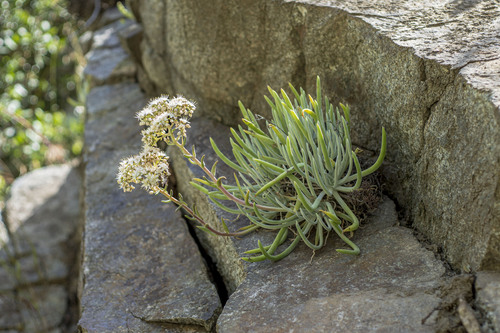
Dudleya densiflora (Rose) Moran is a clumping succulent plant with long, pencil-shaped leaves covered in a white powdery coating. It produces a branching, rounded inflorescence that holds spreading white to pink flowers, which bloom from spring through June. This species resembles Dudleya edulis and Dudleya viscida, but can be distinguished by its white powdery leaves and rounded (rather than flat-topped) inflorescence. Morphologically, it grows in a clumping (caespitose) habit, with multiple leaf rosettes developing on top of branching caudices. Each caudex measures 1 to 2.5 cm (0.39 to 0.98 in) wide. Clumps of rosettes may grow up to 30 cm (12 in) in diameter, with each clump producing 20 to 40 evergreen leaves. The leaves are covered in a white waxy epicuticular powder, with green leaf tissue underneath this coating. If a leaf is wounded, its base may turn yellow. Individual leaves are 6 to 15 cm (2.4 to 5.9 in) long and 6 to 12 mm (0.24 to 0.47 in) wide, roughly cylindrical with a linear shape and an acute tip. The peduncle is 10 to 30 cm (3.9 to 11.8 in) tall and 2 to 6 mm (0.079 to 0.236 in) wide. Floral shoots bear 5 to 15 erect, lanceolate bracts. The inflorescence branches 3 to several times, and each branch may sometimes divide again into one or two terminal branches. These terminal branches are 2 to 4 cm (0.79 to 1.57 in) long, and hold 2 to 8 flowers each, suspended on pedicels 2 to 5 mm (0.079 to 0.197 in) long. Flowers open spreading from the middle, with deltate to ovate sepals. Petals measure 5 to 10 mm (0.20 to 0.39 in) long, are narrowly ovate in shape, and colored white or pink. The full corolla is around 12 to 20 mm (0.47 to 0.79 in) in diameter. This species is restricted to a small locality in southern California, United States. It grows on the southern base of the San Gabriel Mountains, near the mouth of San Gabriel Canyon and Fish Canyon. Its habitat consists of sheer granitic rock faces, cliffs, and canyon walls. Dudleya densiflora is threatened by human activity that encroaches on its native habitat. A major source of disturbance is an operating granite quarry that serves the community of Azusa; the permit for this quarry was issued in 1956, before most modern environmental regulations were enacted. The quarry also blocks the entrance to Fish Canyon, which was previously accessible via a trail maintained by the U.S. Forest Service. In Fish Canyon, this species grows alongside another local Dudleya endemic, Dudleya cymosa subsp. crebrifolia.