About Dudleya cultrata Rose
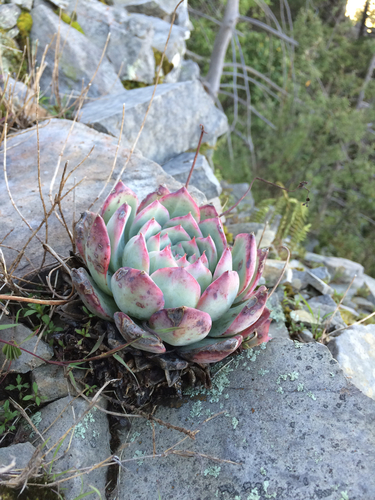
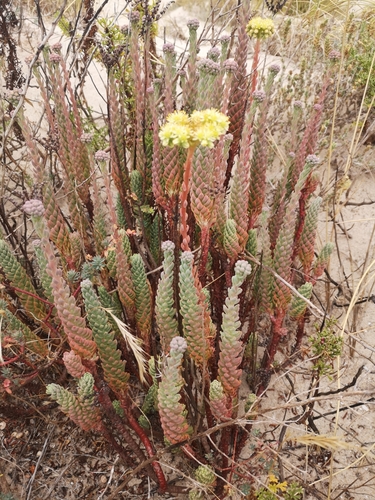
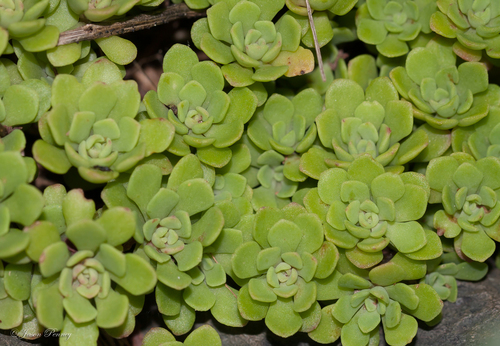
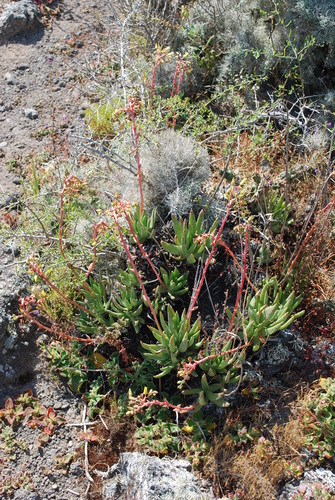
Dudleya cultrata Rose is an evergreen leaf succulent, similar in growth form to most other Dudleya. It grows a basal rosette of leaves atop a caudex, and branches dichotomously, producing multiple rosettes in groups of 2. Compared to the coastal form of Dudleya ingens, this species has noticeably fewer leaves, with a maximum of 25 leaves; it is similar in appearance to the inland form of Dudleya ingens. Its leaves are green, with no glaucousness or wax coating. Flowering stalks can reach up to 40 cm (16 in) in height, and may be reddish or greenish. Its flowers have pale-yellow to yellow petals, which bloom from April to June. Like other members of the subgenus Dudleya, its petals are connate, forming a tube. The caudex of Dudleya cultrata is 2–4 cm (0.79–1.57 in) thick, and may elongate to 20 cm (7.9 in) long. It branches to form clusters with up to 10 rosettes. Each rosette is 3–8 cm (1.2–3.1 in) in diameter, and bears 20–30 leaves. The leaves are oblong, with sides that are parallel or taper from the base. They measure 5–13 cm (2.0–5.1 in) long, 10–15 mm (0.39–0.59 in) wide, and 3–5 mm (0.12–0.20 in) thick, with a flat upper surface and convex lower surface. Leaf margins are acute on the lower fourth of the leaf, and rounded above, with a sub-terete apex. The leaf base is 1.5–3 cm (0.59–1.18 in) wide and 2–3 mm (0.079–0.118 in) high. Floral stems are 20–40 cm (7.9–15.7 in) tall, 3–5 mm (0.12–0.20 in) thick, and bear 5–20 cauline leaves, with no cauline leaves present on the lower 5–15 cm (2.0–5.9 in) of the stem. Cauline leaves are held from horizontal to ascending, and are triangular and acute; the lowermost cauline leaves are around 1–2 cm (0.39–0.79 in) long and 5 mm (0.20 in) wide. The inflorescence is made up of around 3 ascending branches, which may each branch once again. The terminal branches (called cincinni) are 6–25 cm (2.4–9.8 in) long, and hold 6–20 flowers on pedicels. The pedicels are erect, with the lowermost being 5–12 mm (0.20–0.47 in) long. The calyx is 5–6 mm (0.20–0.24 in) wide, 4.5–6 mm (0.18–0.24 in) high, and rounded to tapering at the base. Calyx segments are triangular and acute, 3.5–5 mm (0.14–0.20 in) long, and 2.5–3.5 mm (0.098–0.138 in) wide. Petals are pale yellow, elliptic, and acute, 10–13 mm (0.39–0.51 in) long and around 3 mm (0.12 in) wide, and are connate for 3–5 mm (0.12–0.20 in). Anthers are orange, and carpels are erect. In terms of distribution and habitat, Dudleya cultrata is typically abundant on the coast around San Quintin Bay in Baja California, and also occurs on San Martin Island. Its northern range extends near Colonet, and it can be found south along the El Rosario coast. On San Martin Island, D. cultrata hybridizes with D. anthonyi.