About Dudleya caespitosa (Haw.) Britton & Rose
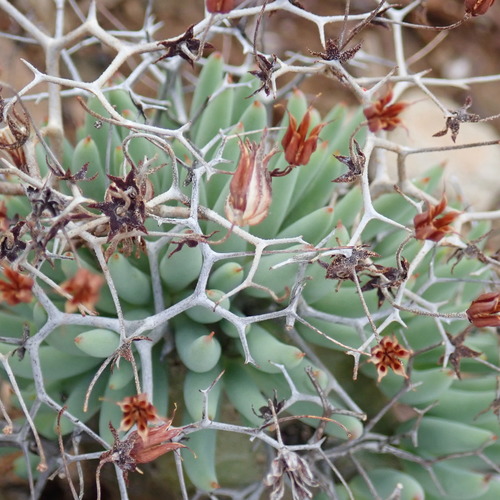
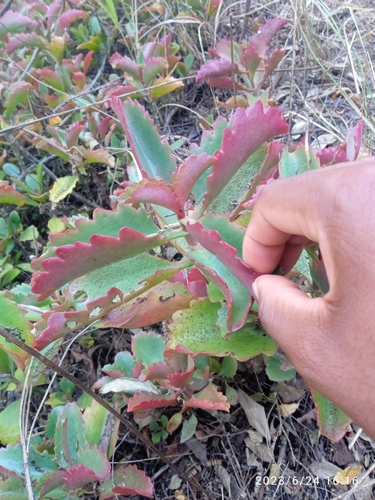
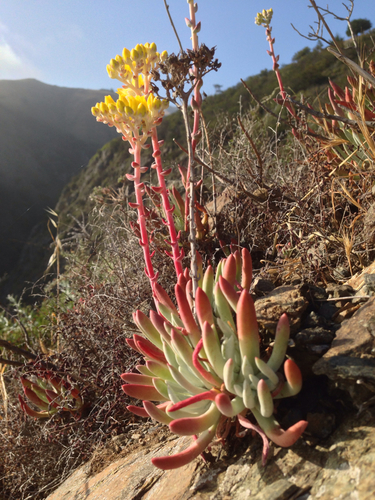
This species is a member of the genus Dudleya, with the scientific name Dudleya caespitosa (Haw.) Britton & Rose. In terms of vegetative morphology, this plant can grow as solitary rosettes, but most often forms loose caespitose clumps that may hold more than 150 rosettes. Individual rosettes range from 8 to 32 cm wide, and contain 15 to 30 leaves each. The caudex measures 1.5 to 4 cm wide, and is typically exposed between dry leaves on older plants. Unlike the related species D. candelabrum, its stem is not swollen at the base. Compared to D. farinosa, it has a longer stem because its internodes are more widely spaced. Leaf shape is extremely variable, but is most often lance-oblong, oblong, or oblanceolate, with leaf tips that are generally acute to sub-acuminate. There is usually no defined angle between the upper and lower leaf surfaces along the leaf margin. Leaf dimensions are typically 5 to 20 cm long, 1 to 2 cm wide, and 3 to 8 mm thick, with leaf bases measuring 0.5 to 4 cm wide. For reproductive morphology, the peduncle is usually 10 to 60 cm tall and 3.5 to 10 mm wide. The inflorescence typically has 3 to 5 first-order branches, which may remain unbranched or branch again up to two times. The branches do not twist, and flowers are borne on the upper side of the branches. Each terminal branch is 3 to 15 cm long, and holds 4 to 15 flowers. There are 12 to 25 bracts, which grow spreading to ascending, and are shaped triangular-ovate to lanceolate. Pedicels are 1 to 6 mm long, erect, and do not bend when the plant develops fruit. Sepals are 2 to 5 mm long, shaped deltate-ovate with an acute tip. Petals are 8 to 16 mm long, 3 to 5 mm wide, shaped elliptic, and are connate (fused) 1.5 to 2.5 mm up their length, forming a tubular corolla characteristic of the subgenus Dudleya. Petals have an acute apex with erect tips, and are generally colored bright yellow, orange-yellow, or red. In terms of distribution and habitat, this common plant grows along the coast of California. Species delimitation for this taxon relies on arbitrary characteristics, so its exact biogeographical distribution is difficult to determine. The 2012 Jepson Treatment places its northern limit at the southern North Coast of the California Floristic Province; plants identified as Dudleya caespitosa range from Point Reyes in the north south to Malibu. Regarding its ecology, near Santa Maria on California's central coast, many oil refineries release phytotoxic sulfur dioxide. While other local plants such as Salvia mellifera (black sage) were negatively impacted by these emissions, Dudleya caespitosa showed some degree of tolerance. This tolerance is thought to come from the species using CAM photosynthesis, which means its stomata only open during evening hours. Combined with nighttime southeast winds that blow refinery emissions away from the area, this combination of CAM physiology and local meteorological conditions allows Dudleya caespitosa to avoid exposure to the phytotoxic emissions.