About Dudleya brittonii Johanss.
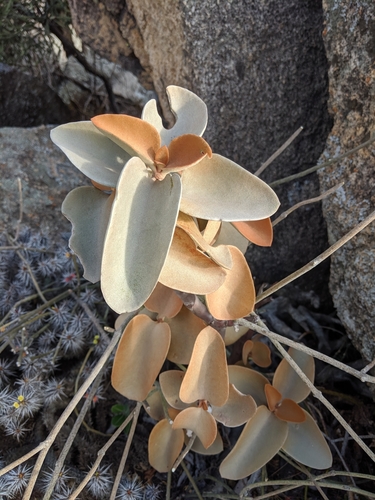
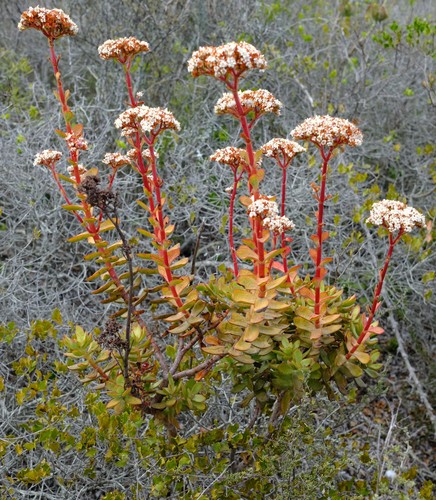
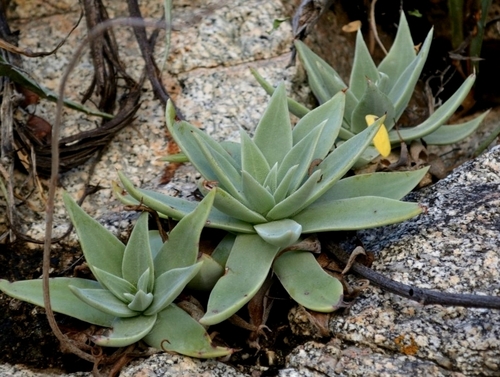
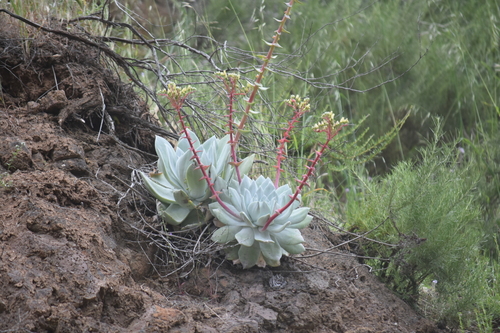
Dudleya brittonii Johanss. has a short, stout caudex, which is often covered in dry leaves. Rosettes usually grow solitarily from the caudex. It produces numerous erect basal leaves. Younger leaves are linear-lanceolate, while older leaves are oblong-lanceolate, much wider, and more turgid at the base. Leaves are 7 to 11 cm long; older leaves measure 4.5 to 5.5 cm wide at the base. Leaves are flat above the middle, but convex on both sides below, with a submedian keel on the upper surface. They are apiculate to acuminate, and often end in a red subulate tip. As leaves age, they turn reddish-heliotrope. The thin, erect, reddish-purple flowering stem grows from the basal leaves. Bracts are horizontal, very thin, and long-lanceolate, they half encircle the stem, and are acuminate. They are light green or red, and tend to wither quickly after flowering. The inflorescence is cymose, about 10 cm across but narrow laterally, with vivid red branchlets that hold erect, slender pedicels 7 to 9 cm long. Flowers have a bright green calyx about 5 mm long, with acute, long-lanceolate segments. The corolla is erect, around 9 mm long, cleft two-thirds of the way to the base, and made up of linear-lanceolate segments. Petals are hyaline to pale white, with yellow coloring on the keel. The glaucous form of Dudleya brittonii has leaves covered in a dusty, chalky, mealy white epicuticular wax. This mealy wax on leaves attracts water, coats water droplets that form on the leaves, and prevents the droplets from evaporating. This plant wax has the highest measured ultraviolet reflectivity of any plant. Dudleya brittonii looks similar to D. pulverulenta, which shares an overlapping distribution with it, and D. ingens, which only occurs further south.
Dudleya brittonii is distributed from extreme northwest Baja California, from La Misión south to the area around Eréndira, and also grows on the island of Todos Santos. The glaucous, white form lives on bluff faces and steep slopes, while the green form grows in rocky areas away from bluffs, and on the flat slopes of talus and soil below bluffs. Coastal development in Baja California is threatening this species.
Dudleya brittonii is cultivated as an ornamental plant, for planting in well-drained rock gardens and grown as a potted succulent. It has received the Royal Horticultural Society's Award of Garden Merit. In temperate climates, it is typically grown under glass in cactus compost, but can be placed outdoors in a sheltered, sunny spot during the summer months.