About Dudleya blochmaniae (Eastw.) Moran
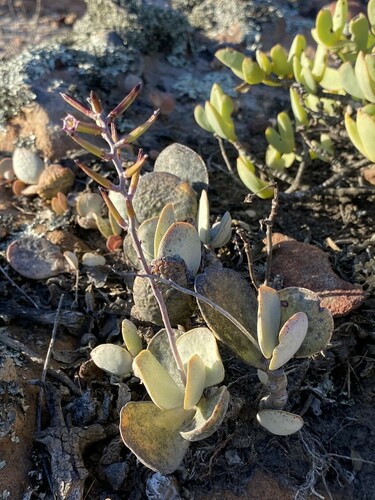
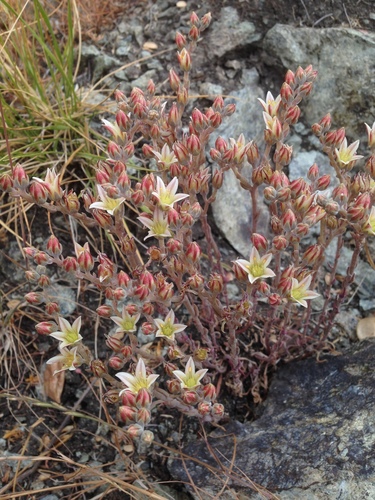
Scientific name: Dudleya blochmaniae (Eastw.) Moran. This species is a corm-like succulent that flowers from late spring to early summer, and often blooms less than one year after sowing. Plants may die back and disappear when grown in locations with high rainfall. Vegetative morphology: The plant produces a small basal rosette from an underground corm. The rosette ranges from only 0.5 to 7 cm across. Its leaves are summer deciduous, 1 to 6 cm long, 1 to 4 mm wide, and are most commonly oblanceolate to club-shaped. Leaf tips vary from acute to rounded, and leaves are attached to the rosette via a more or less narrow petiole. When a leaf is removed from the plant, the wound at the detachment point turns red. Reproductive morphology: The inflorescence branches 2 to 3 times, and may or may not branch an additional time. The terminal branches of the inflorescence are 1 to 6 cm long and hold 3 to 10 flowers each. Lower bracts on the inflorescence are often more than twice as long as they are wide. Pedicels are less than 1 mm long. Flowers are white and star-shaped. Sepals are 1.5 to 4 mm long, shaped deltate to ovate. Petals spread out from the base, measure 5 to 10 mm long, are elliptic in shape with an acute tip, and are colored white. The keel of the petals is often marked with fine red lines.