About Dudleya arizonica Rose
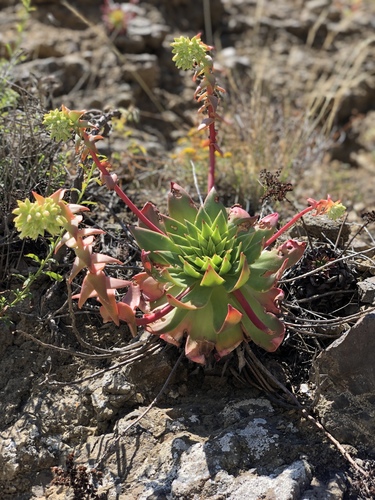
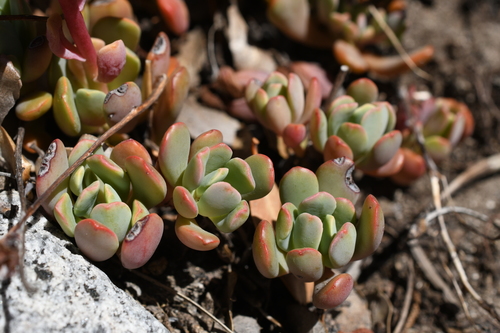
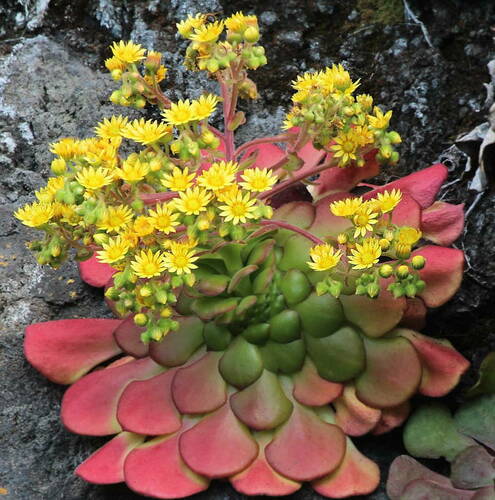
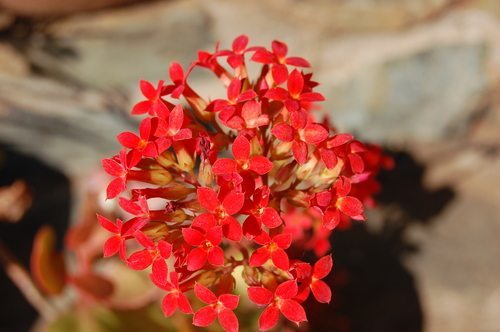
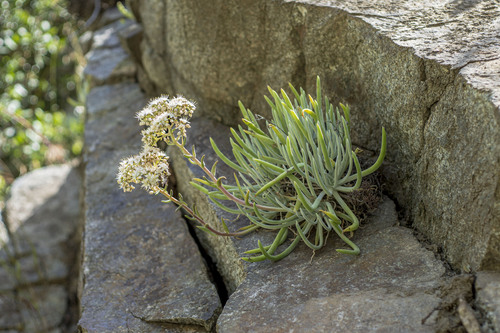
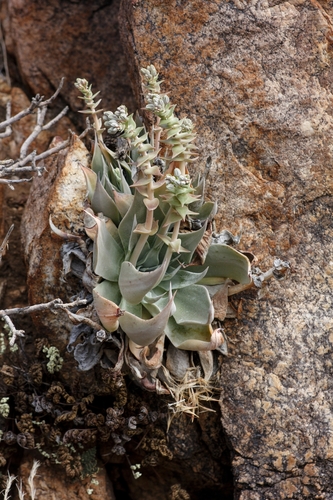
Dudleya arizonica Rose is a moderately-sized Dudleya species. It grows from a caudex (basal stem) that is 1 to 4 cm wide, which bears one, or sometimes multiple, rosettes. Individual rosettes are typically 10 to 25 cm wide. Each rosette is made up of 15 to 30 leaves, which are generally farinose (covered in a powdery coating) and greenish-white. Leaves are usually held upright in the center of the rosette; the rosette may form a cup shape with leaves remaining upright, or leaves may lie flat further from the rosette center. Leaves measure 5 to 15 cm long, 1 to 5 mm wide, and 2 to 4 mm thick. They are shaped oblong to oblong-obovate, with a long-acuminate (long, tapering) tip. Some leaves may have a bronze tint, and older plants develop wrinkled, shrunken foliage. The flowering peduncle (stem) grows 15 to 60 cm tall and 2 to 6 mm thick. It bears 30 to 45 closely set ascending bracts arranged in a spiral around the stem. The bracts are long-triangular, 2.5 to 3.8 cm long and 1.5 to 1.9 cm wide. The peduncle branches into 3 to 6 secondary branches, each around 4 to 27 cm long. Flower buds grow from a near-horizontal to upright orientation, and stay erect once fully developed. Flowers are borne on 5 to 15 mm long pedicels, and have red or apricot-yellow petals. This species is native to a large portion of the desert southwestern United States and northwestern Mexico, occurring in Arizona, Baja California, California, Nevada, Utah, and Sonora. In the United States, it is found across central and western Arizona, the desert southwest of California extending up the eastern slope of the Peninsular Ranges, and southern Nevada. There is also a disjunct population in Utah's Beaver Dam Mountains, where plants grow only on limestone outcrops; this Utah population is threatened by overcollecting, recreational activity, and urban expansion. In Baja California, the species occurs in the Peninsular Ranges (continuing from California into Guadalupe Valley) but does not reach the coast. It extends south through desert sky islands, reaching its southern limit on Ángel de la Guarda Island. In Sonora, it grows along the desert coast from the Colorado River delta and Puerto Peñasco to the area just north of Tiburón Island.