About Ducula whartoni (Sharpe, 1887)
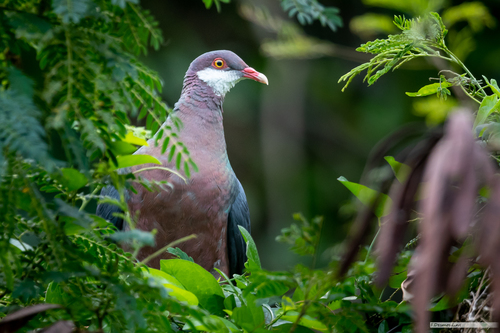
An adult male Christmas imperial pigeon measures an average of 435–470 mm (17.1–18.5 in) in total length, while adult females measure an average of 440–460 mm (17–18 in). Male wing length averages 250–264 mm (9.8–10.4 in), and female wing length averages 231–258 mm (9.1–10.2 in). Males weigh an average of 383–700 g (0.84–1.54 lb), and females weigh an average of 406–575 g (0.90–1.27 lb). This species is rather large for an imperial pigeon, though it is relatively lightly built. Its overall plumage is grey-black, with darker feathers on the upper body, and lighter feathers with a burgundy tinge on the breast and belly. The beak is black, with a narrow white band at the base of the upper beak. Eye color ranges from yellow to orange. The nape and back have a glossy oil-green color. The wing feathers have glossy bluish-green tips and are greyish-brown closer to the base. The tail has broad greenish-brown tips with a somewhat scalloped shape, and the legs and underside of the tail are covered in reddish-brown feathers. The feet are purple-red. Juveniles have a similar appearance to adults, but have duller coloration that lacks the oil-green gloss from the lower back to the tail coverts. They have a brown breast and belly, a dull grey crown, and grey-brown feet, with dark brown eyes. The Christmas imperial pigeon produces a soft gurgling or purring coo sound. It can also make a deep whoo or croo-croo-croo sound that has been compared to a cow mooing in the distance. It sometimes makes loud clapping sounds with its wings, but is largely quiet during flight. This species is endemic to Christmas Island, a 135 km² (52 mi²) tropical island in the eastern Indian Ocean. It predominantly lives in the island's evergreen inland plateau, but can be found across the entire island. Around one third of the island's original evergreen forest was cut down for phosphate mining, but introduced Jamaican cherry trees have recolonized many of these areas. The Christmas imperial pigeon was introduced to the Coco Islands, likely to Horsburgh Island, between November 1888 and August 1890, and the last confirmed sighting of the species there was made in 1906. Along with the Christmas Island flying fox, the Christmas imperial pigeon is one of only two major frugivorous (fruit-eating) animals on Christmas Island. Because of this, it plays an important role in seed dispersal: it swallows seeds whole, and the seeds remain intact after passing through the bird. Like other imperial pigeons, it can stretch the base of its jaw to eat larger food items. It has been recorded feeding on small-seeded plants including stinkwood (Celtis timorensis), the common fig, the chinaberry tree, Syzygium nervosum, Tristiropsis acutangula, and the introduced Jamaican cherry. The introduced Jamaican cherry has become a very important food source for the species, and hundreds of pigeons have been sighted in areas where this plant is common. It generally feeds in flocks in the canopy, on isolated trees, or in shrubs, and will descend to drink from springs or puddles. It has also been observed feeding alone or in pairs. Although it is primarily frugivorous, it has been repeatedly observed consuming leaves of the introduced papaya plant (a behavior called folivory). This folivory may be caused by an island-wide shortage of fruit, or less likely, it may be done for some therapeutic reason. The species' peak foraging time is just before dusk. The Christmas goshawk has been observed preying on Christmas imperial pigeon chicks.