About Ducula goliath (G.R.Gray, 1859)
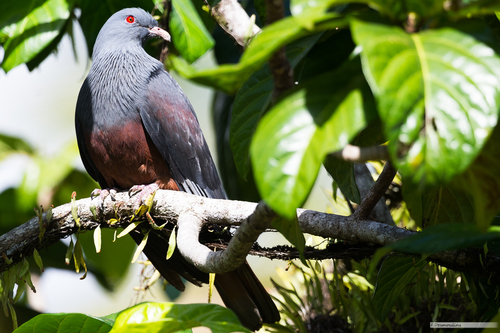
The goliath imperial pigeon, scientifically named Ducula goliath (G.R.Gray, 1859), reaches about 51 centimeters (20 inches) in length, which makes it one of the largest species of arboreal pigeon. It is a slender bird with a long tail, and weighs between 600 and 716 grams (21.2 to 25.3 ounces). Its head and neck are blue-grey. Its upperparts and wings are sooty-grey, with a grey panel on the bases of the primary feathers. Its tail is black and marked with a dark chestnut band. The feathers on its neck and upper breast are bifurcated, which gives these areas a shaggy or furrowed appearance. Its lower breast is sooty-grey, its belly and flanks are purplish-chestnut, and its vent is buffy-yellow. Its eye is bright red, and its beak and feet are pinkish or vinous-red. Juvenile birds have duller plumage, and lack the bifurcated feather structure seen in adults. This pigeon is endemic to New Caledonia, where it occurs on Grande Terre and the Isle of Pines. It mostly inhabits humid primary forest, and can be found up to 1,500 meters (4,900 feet) in elevation.