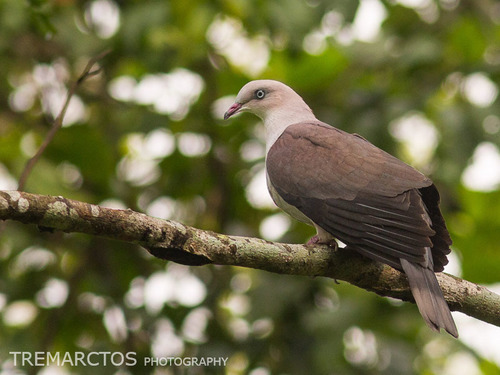
About Ducula badia (Raffles, 1822)
The mountain imperial pigeon, with the scientific name Ducula badia (Raffles, 1822), is the largest pigeon species within its range, measuring 43 to 51 cm (17 to 20 in) in length. It has a fairly long tail, broad rounded wings, and slow wing beats. Its head, neck, and underparts are vinous-grey, paired with a contrasting white throat; its upperparts and wings are brownish-maroon, though the upper body can appear duller. The underwing is slate-grey, and the tail is blackish with a grey horizontal stripe. The combination of its maroon back and large body size gives this species a distinct look. Its call is a deep, resonant boom that can only be heard at close range. This pigeon has a broad distribution across southeastern Asia, and can be found in Bangladesh, Bhutan, Brunei, Cambodia, China, India, Indonesia, Laos, Malaysia, Myanmar, Nepal, Thailand, and Vietnam. Its natural habitats are subtropical or tropical moist lowland forests, subtropical or tropical mangrove forests, and subtropical or tropical moist montane forests. It occurs from sea level up to 2,550 m (8,370 ft) in the Himalayas, and up to 2,200 m (7,200 ft) on Sumatra. It is mainly a foothill bird, and it probably only breeds at elevations above 500 m (1,600 ft), though feeding flocks are commonly seen below this elevation. It typically inhabits old-growth forests, and the species is generally fairly common in areas where large, continuous stands of forest still stand.