About Dryoscopus cubla (Latham, 1802)
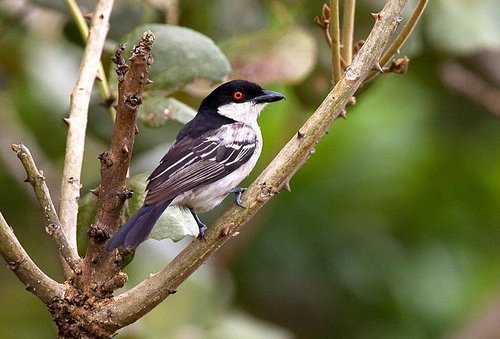
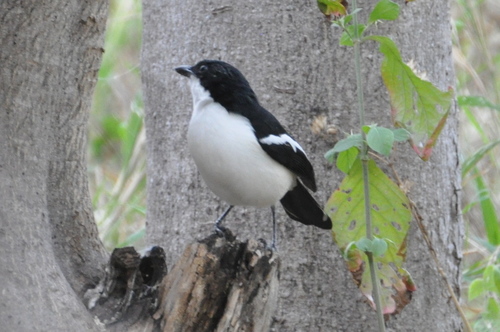
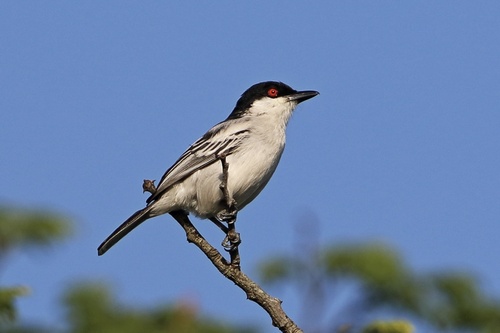
Dryoscopus cubla, first described by Latham in 1802, measures approximately 17 cm in total length. While the sexes share a general similar appearance, they are easily distinguishable from one another. Adult males have deep blue-black upperparts with a subtle sheen. A black cap sits above the red eye, the upperparts have black-and-white plumage, and the underparts are completely pure white. Females have a black loral stripe, white supraloral feathers, pale ear coverts, and a crown that is not solidly black. They also have grayer backs than males, with grey to buffy tones in their white plumage areas. Immature birds look similar to females, but have brownish bills and brown irises. Their upperparts and flanks are even grayer, and their underparts and the edges of their wing feathers are more buffy. This species shows clinal intraspecific variation. Traits including range, iris colour, wing markings, and female plumage help distinguish Dryoscopus cubla from other puffback species. Dryoscopus cubla occurs primarily south of the equator in sub-Saharan Africa, ranging from southern Somalia to coastal South Africa. North of and near the equator, it is replaced by the slightly larger northern puffback, with which it forms a superspecies. This species is commonly found in gardens, riparian thickets, mangroves, woodlands, moist savanna, and less commonly arid savanna, bushveld, and especially in southern regions, the fringes of afromontane forest. It occurs from sea level up to around 2,200 metres above sea level, and it is the only puffback species present across much of its range. The highest reporting rates for this species come from the densest woodlands, though all woodland types are used, including Racosperma plantations. In southern Africa, the highest reporting rates are from miombo woodlands including the Eastern Highlands, gusu woodlands, mopane woodlands, and various mixed moist or arid woodlands, as well as riparian fringing forest including that of the Okavango Delta. A density of one breeding pair per 42 hectares was recorded in broadleaved Terminalia-Burkea woodland at Nylsvley, South Africa, and a breeding territory is estimated to cover around 4 hectares. Intensive farming and human activity have destroyed large areas of the species' natural habitat in the Eastern Cape and KwaZulu-Natal provinces of South Africa. Dryoscopus cubla is naturally absent from arid Acacia scrub, Acacia savanna on the Zimbabwean plateau, and the treeless highveld and alpine regions of southern Africa. It also does not occur in the Congo Basin, and mostly avoids the tree canopies in the interior of afromontane forests.