About Dryopteris marginalis (L.) A.Gray
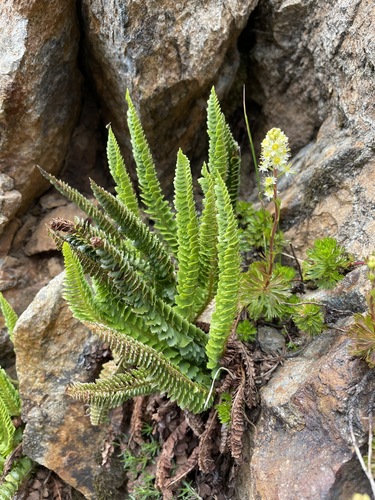
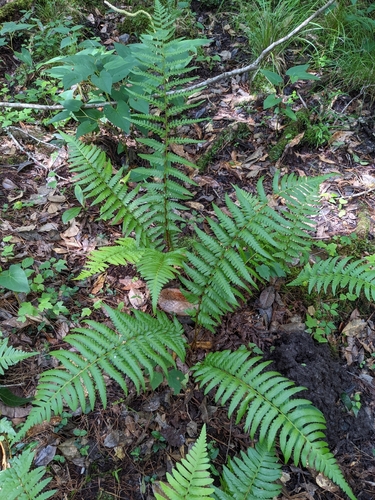
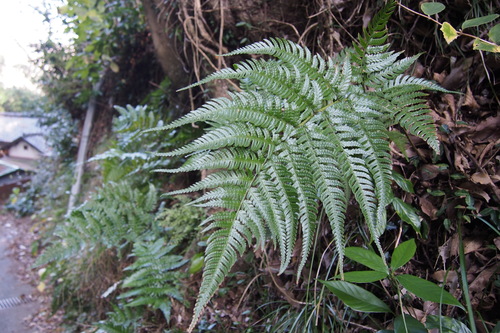
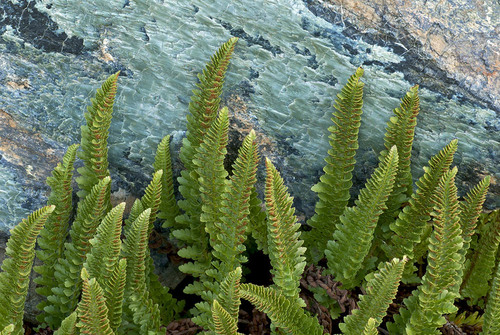
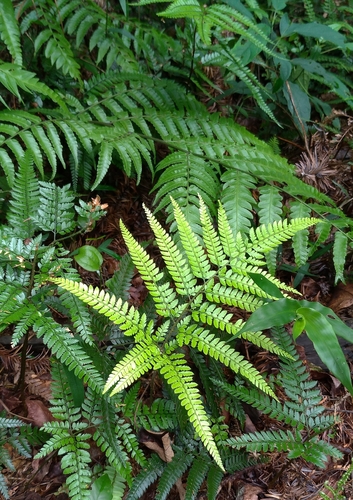
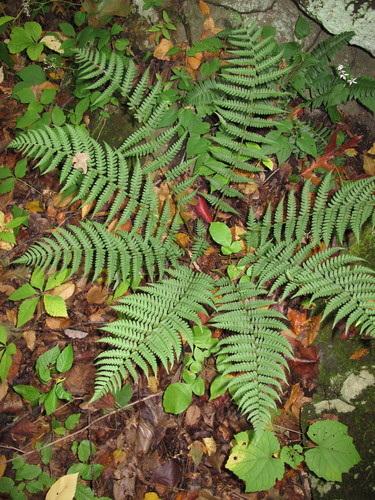
Dryopteris marginalis, also called marginal wood fern, is an evergreen fern across its entire range. Along with Christmas fern (Polystichum acrostichoides), it is one of only a few evergreen fern species. This fern grows in a clump from a prominent central rootstock; the rootstock may be exposed, giving the fern an appearance similar to a small tree fern. Dead leaves often accumulate beneath the growing plant. The stipe, the stem that supports the leaf, makes up roughly one quarter of the total leaf length, and is covered in bright golden brown scales. The stipe is grooved on its upward-facing side, dark red-brown at the base, and shifts to green further up toward the leaf blade. The leaf blade is dark blue-green, with a thick, leathery texture. It reaches 1 to 2 feet in height, and about 6 inches wide. Each leaf blade is divided into leaflets arranged on opposite sides of the central stalk. The tips of these leaflets typically curve toward the tip of the whole leaf. The leaflets are further divided into subleaflets, which have blunt tips and are either serrated or lobed. Fertile leaflets, which bear sori and spores, are similar in size and appearance to sterile leaflets. Round sori are positioned along the margins of the leaf tissue. Before ripening, the sori start gray, shift to a distinct blue-violet color, and finally turn brown when fully mature. Each sorus is covered by a smooth, kidney-shaped indusium. Dryopteris marginalis has a wide distribution across the northeastern United States. It was first discovered in Minnesota in 1981; it was likely a longstanding part of the state’s native flora but overlooked due to its rarity and close similarity to related species. It is listed as a threatened species in Minnesota, not because the species is currently threatened overall, but because only one population exists there, growing on an east-facing sandstone bluff capped with limestone. In other parts of its range, it grows in woods, on talus slopes, in rocky areas and on rock walls, on wooded slopes and in ravines, and along the edges of woods, streams, and roads. Dryopteris marginalis is cultivated in gardens, where it grows in partial to full shade. It is an evergreen, non-spreading fern that forms a vase-shaped clump of leathery, deeply cut fronds. It is used in shade gardens, rock gardens, and native plantings. It has no serious insect or disease issues, and is winter hardy in USDA zones 3 through 8. Dryopteris marginalis is known to form hybrids with 10 other Dryopteris species; some of these hybrids are common. They can be identified by their malformed spores and sori that do not sit exactly on the leaf margins.