About Dryopteris goldieana (Hook. ex Goldie) A.Gray
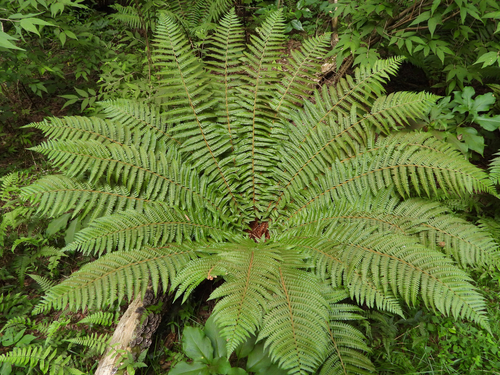
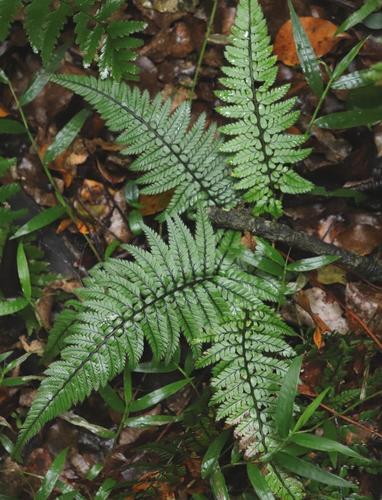
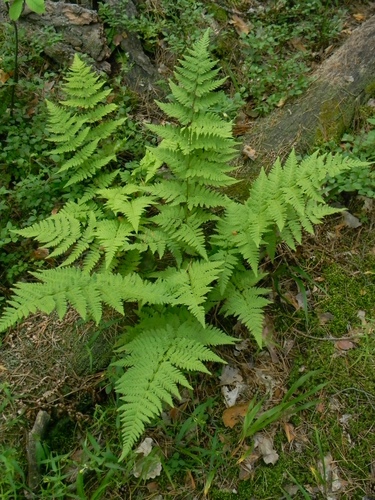
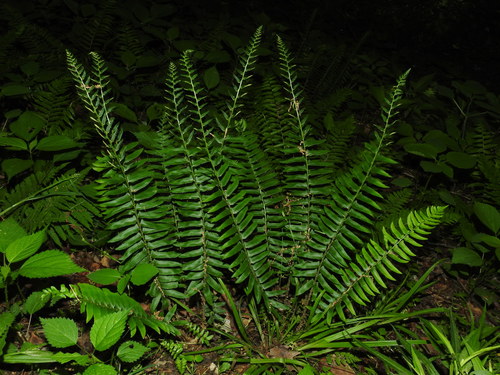
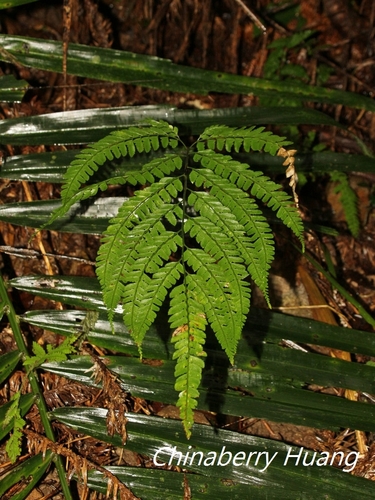
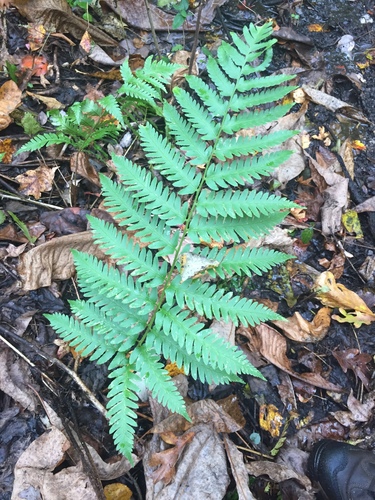
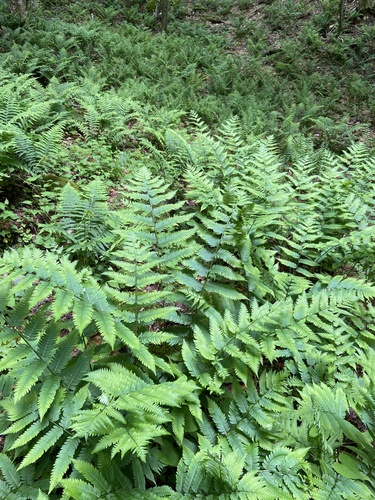
Goldie's fern (Dryopteris goldieana) commonly grows in moist, rich woods, ravines, seeps, the edges of swamps, and areas with full or partial shade. It grows in clumps, where all leaves emerge from the same point on the ground. The stipe is the section of stem that grows from the roots and does not hold leaflets. Towards its base, the stipe is very densely covered in dark brown to black scales, which may have a tan border; scale density decreases as the stipe approaches the leaflet-bearing area. The stipe makes up one-third of the total leaf length, is flat or slightly channeled on its upper side, and is dark brown to nearly black at the base, fading to green further from the base. The rachis (axis that supports the leaflets) is green and also covered in pale scales. Leaf texture is rather thick, but the fern is not evergreen. Leaf color ranges from dark green to golden green. Individual leaves measure 35–120 cm in length and 15–40 cm in width. The base of the leaf does not taper strongly, and the bottom leaflets are only slightly smaller than the leaflets directly above them. A distinctive characteristic that helps distinguish this fern from similar species is that the leaf tip is rather short or abruptly tapering; some specimens also have white mottling on the leaf tip. The leaf is divided into many pairs of leaflets: most are pinnate, but some near the bottom of the leaf may be bipinnately divided. Leaflets typically taper at both the base and tip, and connect to the main stem via a short stem. Leaflets are themselves divided into many subleaflets, which are oblong or elliptic with a pointed tip and toothed edge. Subleaflets are generally curved so that their tip points toward the tip of the parent leaflet. Fertile leaflets (which bear spores and sori) and sterile leaflets (which lack spores) have identical shapes. Sori are typically positioned near the midvein, and are covered by a smooth, kidney-shaped indusium. Each fertile leaflet holds 6–8 pairs of sori, paired across the midvein. In midsummer, spores turn brown, ripen, and are released into the wind. This species is one of the parent species of the polyploid hybrids Dryopteris celsa and Dryopteris clintoniana. Mature plants reach between one and a half to two feet in height. It is more closely allied to Aspidium Cristatum than any other species in the genus, but is clearly distinguishable by the greater breadth of its frond, which gives it a quite different outline, and by the form of its pinnae: pinnae are never broader at the base, and are instead narrower than several of the segments just above them. These segments are also longer and narrower, slightly falcate, and those of the lowermost pinnae are never lobed, only simply serrated at the margin. The serratures are also tipped with more distinct, though short, spinules. Fructifications are located centrally near the midrib; this trait prevents the species from sharing a considerable affinity with A. marginale, which it would otherwise have. For cultivation, Goldie's fern requires medium sunlight or shade, high humidity, moist soil rich in organic matter, and protection from wind to thrive.