About Dryopteris carthusiana (Vill.) H.P.Fuchs
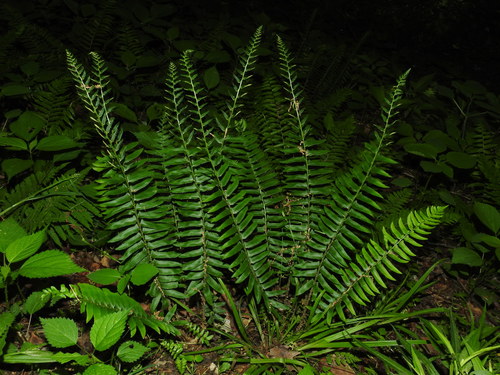
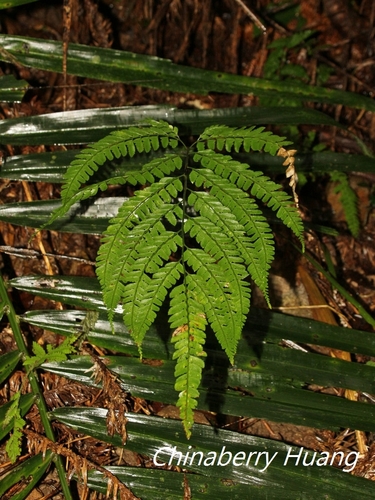
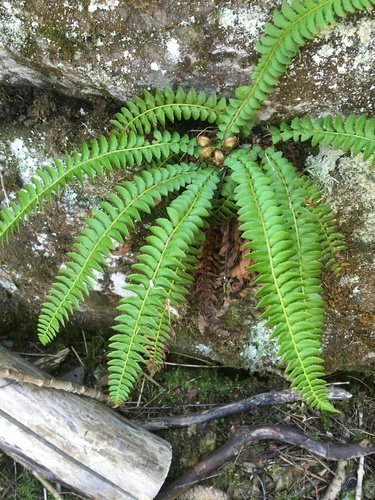
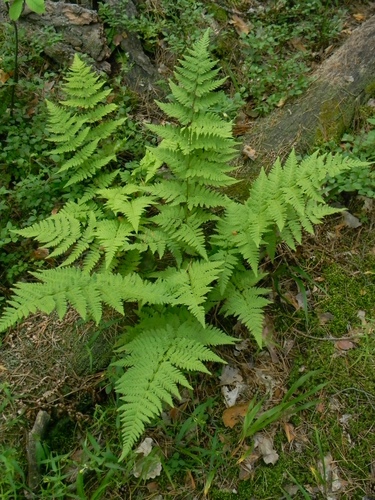
This dark green fern has an upright growth habit and grows in sparse clusters of leaves, with a short rootstock. Its leaves are upright, overwintering, and reach 30 to 50 centimeters in length. The leaf stalk is roughly the same length as the leaf blade, and covered in light brown scales. The leaf blade is narrowly ovate and double pinnate, with narrowly triangular leaflets. Round, kidney-shaped sori containing sporangia grow on the undersides of the leaves. This fern is frequently confused with other wood fern species, including Dryopteris intermedia, D. campyloptera, and D. expansa. It shares a large portion of its range with D. intermedia, but the two can be told apart by the innermost pinnule on the lower surface of the bottom pinna: in D. carthusiana, this pinnule is longer than the adjacent pinnules, while in D. intermedia it is shorter or even in length. D. carthusiana is a sub-evergreen species: its fronds survive mild winters, but die back during harsh winters. For habitat, this fern prefers acidic soil and avoids lime-rich soils and spring areas that many other pteridophytes favor. It tolerates direct sunlight slightly better than its close relatives, so it can grow in some logging sites and even benefits from these areas. It commonly grows in moist forest depressions, nemoral forests, coastal scrubs, fresh cliff faces, ditch sides, coniferous swamps, and herb-rich hardwood-spruce swamps (called ruohokorpi in Finnish). It is able to use artificial light to grow in areas that have no natural light, such as Niagara Cave.