About Dryophytes versicolor (LeConte, 1825)
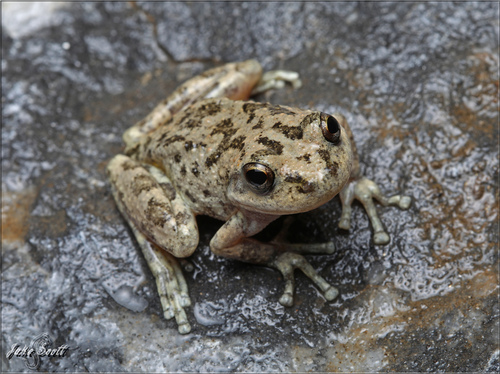
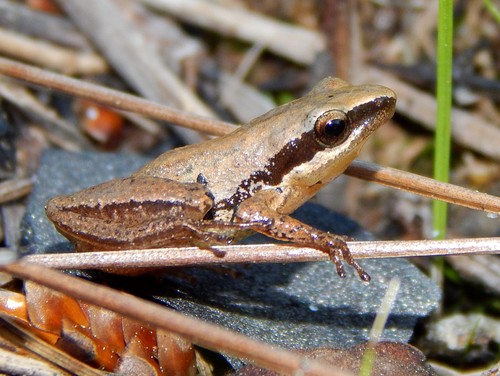
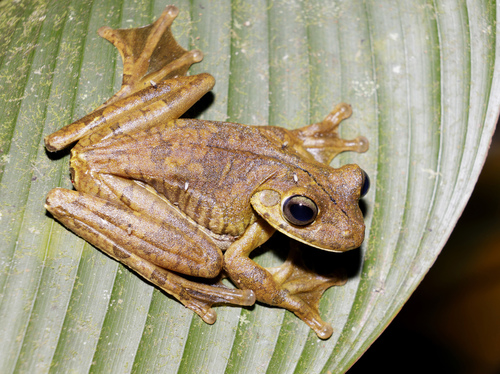
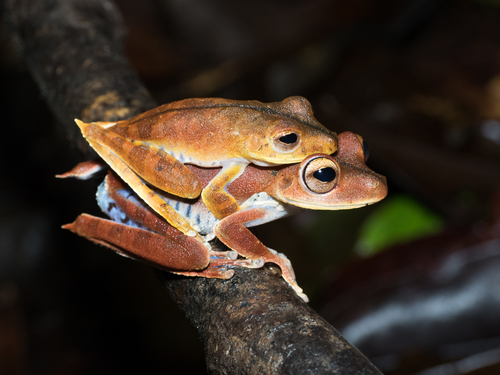
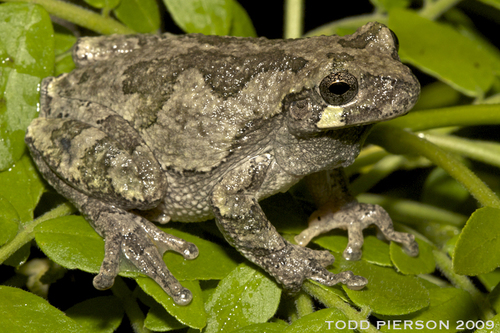
As the scientific specific epithet versicolor suggests, the gray treefrog (Dryophytes versicolor) is variable in color. It can adjust its color from gray to green or brown to camouflage itself to match its surrounding environment, and is even able to shift between nearly black and nearly white shades. It changes color more slowly than a chameleon. A unique feature of the species' appearance is a dark banded pattern on its legs, which contrasts sharply with the bright yellow or orange, black-marked underside of its leg and arm sides. Dead gray treefrogs and individuals kept in unnatural surroundings are predominantly gray. Females do not produce calling vocalizations, while males do. Adult females are typically larger than adult males. Compared to other North American frog species, the gray treefrog is relatively small, usually reaching no more than 1.5 to 2 inches (3.8 to 5.1 cm) in snout-to-vent length (SVL). Its skin has a lumpy texture that gives it a warty appearance. This species is nearly identical in appearance to Cope's gray treefrog; the only readily noticeable difference between the two is that Cope's gray treefrog has a shorter, faster call. Both species' call rates are dependent on temperature, so this difference varies with temperature. At lower temperatures, Cope's gray treefrog can have a call rate close to that of Dryophytes versicolor. The difference in calls can be heard, but is most accurately measured by counting the number of pulses per second in their whistled trills. At typical temperatures, Dryophytes versicolor has a pulse rate of 16 to 34 pulses per second, while Cope's gray treefrog has a pulse rate of 34 to 60 pulses per second. Even though there is potential for overlap in pulse rate, the two species are easily distinguished where they occur together because of the temperature dependence of pulse frequency. At any given temperature, the pulse frequency of the gray treefrog is approximately half that of Cope's gray treefrog. The gray treefrog has 48 chromosomes (4n), so it is sometimes called the tetraploid gray treefrog in scientific literature. By contrast, Cope's gray treefrog (also called the diploid gray treefrog) retains the original 2n chromosome count of 24. Hybridization between the two species results in early mortality for many larvae. Some hybrid individuals do survive to adulthood, but they have reduced fertility. Both of these similar gray treefrog species have bright-yellow patches on their hind legs, which separates them from other treefrogs such as the bird-voiced tree frog. These bright patches are normally only visible when the frog is jumping. Both gray treefrog species are slightly sexually dimorphic: males have black or gray throats, while females have lighter throats. Gray treefrog tadpoles have rounded bodies, unlike the more elongated bodies of stream-dwelling frog species. They also have high, wide tails that can turn red if predators are present in their habitat. Metamorphosis can happen as quickly as two months when conditions are optimal. During metamorphosis, newly developed froglets almost always turn green for one to two days before shifting to the more common gray coloration. Young frogs may sometimes keep a light green color, and only turn gray or darker green once they reach adulthood. The gray treefrog has a wide geographic range, found across most of the eastern half of the United States, and extending west as far as central Texas and Oklahoma. It also ranges into Canada, occurring in the provinces of Quebec, Ontario, and Manitoba, with an isolated population in New Brunswick. This species can survive freezing of its internal body fluids at temperatures as low as −8 °C (18 °F). It is most common in forested areas, as it is highly arboreal. Its calls are frequently heard in rural residential areas of the U.S. East Coast and Midwest. It prefers to breed in semipermanent fish-free woodland ponds, but will also lay eggs in swamps, vernal pools, man-made fountains, water gardens, and even rainwater-filled swimming pool covers.