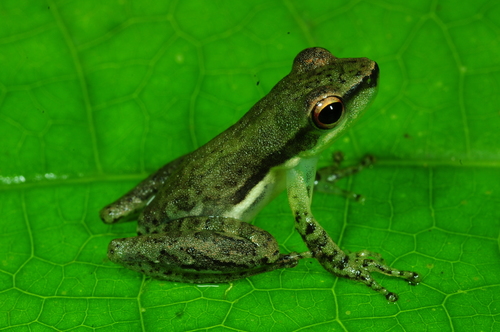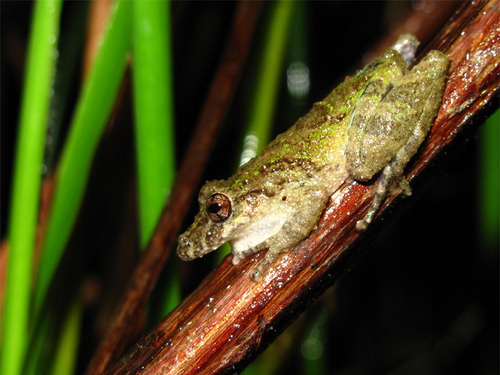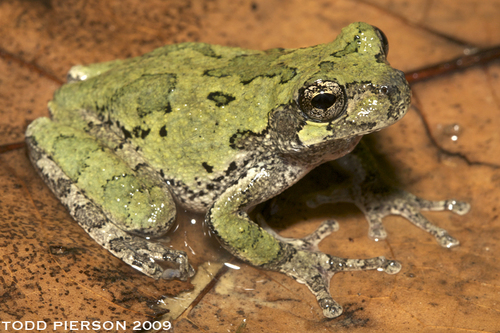
About Dryophytes chrysoscelis (Cope, 1880)
Dryophytes chrysoscelis, also called Cope's gray treefrog, shares several key traits with Dryophytes versicolor. Both species have black-marked bright orange to yellow patches on their hind legs, a feature that sets them apart from other treefrogs like Dryophytes avivoca. These bright-yellow patterns are normally hidden when the frog is at rest, but become exposed when it leaps. This so-called "flash pattern" likely functions to startle predators while the frog escapes. Similar hidden bright patterns are common across many Lepidoptera, for example moths in the genus Catocala. The skin color and pattern of Dryophytes chrysoscelis changes based on the environment the frog lives in. Both species of gray treefrog are slightly sexually dimorphic. During the breeding season, males have black or gray throats, while females have lighter throats. Younger frogs of this species are usually greenish overall during breeding seasons; as they age, they lose this green coloration and develop the species' characteristic gray color. Skin secretions from this species can be irritating or toxic to the mouth, eyes, and other mucous membranes. The distribution range of Dryophytes chrysoscelis is more southerly than that of D. versicolor. In Virginia and the Carolinas, D. chrysoscelis is the species found in the lower elevation Piedmont and Coastal Plain, while D. versicolor is typically only found in the Appalachians in these regions. Although this species is most abundant in the southeastern United States, it can be found as far north as Manitoba. Dryophytes chrysoscelis has been observed to have freeze tolerance in laboratory settings, a trait that may help it survive in cold climates. It is one of very few frog species that can mobilize glycerol as a cryoprotectant. Glycerol production is low at warmer temperatures, but the body rapidly produces glycerol when temperatures get colder. When studying ice concentration in overwintering frogs, researchers found that 40 to 50% of the frog's total body water becomes frozen. Studies indicate that Cope's gray treefrog may be more resilient to long-term climate change, although individual populations can experience short-term negative effects. Because of this resilience, researchers expect that the species' overall distribution will change little in the long term. Dryophytes chrysoscelis prefers to perch on pipes along wetland edges, near trees. This preference indicates that the terrestrial habitat surrounding wetlands is an important part of the species' overall habitat. The bird-voiced treefrog, D. avivoca, is similar to D. chrysoscelis and D. versicolor, but is smaller in size: D. avivoca reaches 25–50 mm in length, while gray treefrogs reach 32–62 mm.