About Dryomyza anilis Fallén, 1820
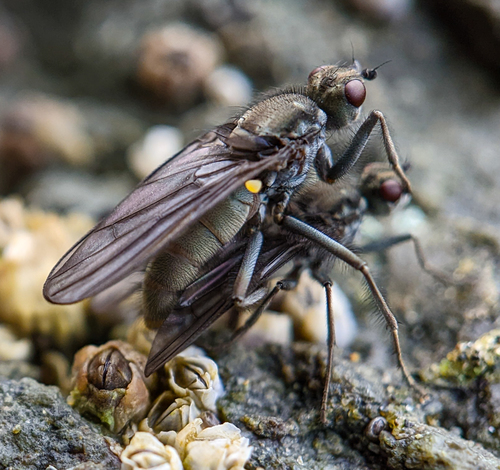
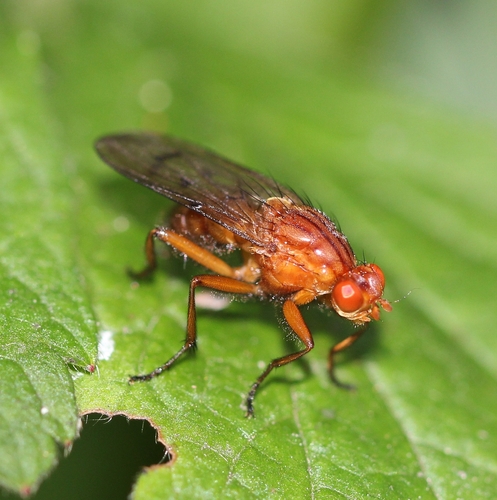
Dryomyza anilis adults are medium-sized, with an overall length ranging from 7–14 mm, and a typical length of 12 mm. They are light-brown and orange in color, with large red eyes. This species can generally be distinguished from other Dryomyzidae species by its nearly bare arista (apical bristle), covered lunule (a crescent-shaped mark found around the wing margins), and fully developed prostigmatic and prescutellar bristles. Dryomyzidae as a family are characterized by closely spaced first antennal segments, a protruding oral margin, a strap-shaped or oral prosternum that is not joined to the propleura, and an absence of costal spines. D. anilis has short posterior spiracular tubes, no hooks on its posterior spiracular plates, and well-developed tubercles only on segment 12. In laboratory settings, D. anilis has a lifespan between 28 and 178 days. D. anilis is a Holarctic species, found in Canada and many northern U.S. states within the Nearctic realm. It is also widespread across the Palearctic realm, ranging from the United Kingdom to Japan. Within the United Kingdom, it is common and widespread in England and Wales, but less common in Scotland. In the wild, D. anilis is typically most prevalent from May to September. Adults inhabit moist, shady areas among low-growing vegetation and around excrement; specific recorded adult habitats include human excrement, fox and pheasant carrion, and malodorous stinkhorn fungi. Eggs of this species have been found in human excrement, and larvae have been found in pheasant carrion. D. anilis can complete development from egg to pupa on dead animal matter, but cannot do so on decaying plant matter. Experimental trials show larvae cannot reach maturity when grown on rotting grass, decaying pumpkin flesh, decaying lettuce, or cow manure. They do successfully reach maturity when grown on hamburger, dead earthworms, dead crane flies, dead polygrid snails, a dead milkweed caterpillar, a dead slug, and rotting agaric mushrooms. Ecologically, D. anilis can survive on food sources ranging from insects and vertebrates to rotting fungi. Pharyngeal ridges in larval skeletons indicate larvae obtain nutrition from micro-organisms found in rotting organic food. These ridges act as a selective sieve for food, ensuring only nutritious material enters the digestive system. Larvae that feed on living tissue do not have these pharyngeal ridges. D. anilis has a short incubation period of around 24 hours, which may give it a competitive advantage when exploiting limited resources. No predators or parasites of D. anilis have been formally studied to date, however experiments have shown that several larvae of Mydaea urbana can destroy a large D. anilis population developing on human excrement.