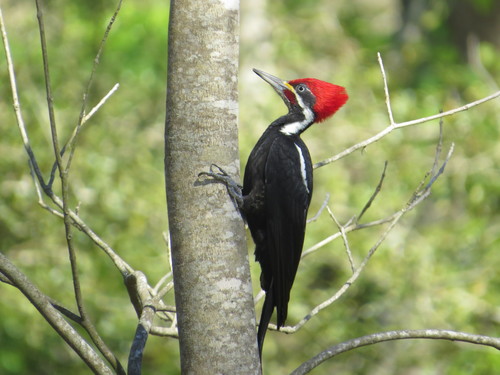
About Dryocopus schulzii (Cabanis, 1882)
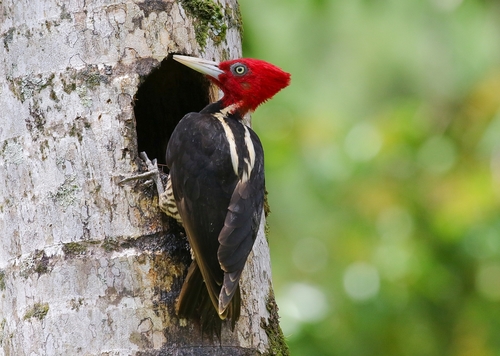
Description: The black-bodied woodpecker measures 29 to 30 cm (11 to 12 inches) in length. Both sexes have a long, pointed crest. Adult males have a red forehead and red crest; their ear coverts are gray, they have a very thin, short white stripe behind the eye, a white stripe that runs from the lores to under the ear coverts and continues down the side of the neck, a red malar stripe with a small patch of black at its rear end, and a white chin. Adult females differ from males only by having a black malar stripe and a blackish lower forehead, and are otherwise identical. Adult individuals of both sexes have black throats and black hindnecks, and are mostly black below the neck. The southern population of the species has entirely black scapulars; individuals in the northern population have white coloring on the outer webs of their scapulars that extends the white line running along the neck. Their flight feathers are black with white bases. The upper side of their tail is black with white feather shafts, while the underside is black to brownish black. Their flanks and lower belly often have faint yellowish barring. Their bill is a long, pale ivory-white chisel shape with a darker culmen and base; their iris ranges from deep brown to red-brown, and their legs are dark gray. Juveniles are duller and browner than adults, and have more extensive barring on their flanks. Distribution and habitat: The black-bodied woodpecker is found from the southern Bolivian departments of Santa Cruz and Tarija, south through western and central Paraguay, into north-central Argentina as far as the provinces of Córdoba and San Luis. It inhabits dry Gran Chaco woodlands and savannas, as well as the transition zones between these areas and moister montane forest. It occurs at elevations up to 1,000 m (3,300 ft).