About Dryocopus pileatus (Linnaeus, 1758)
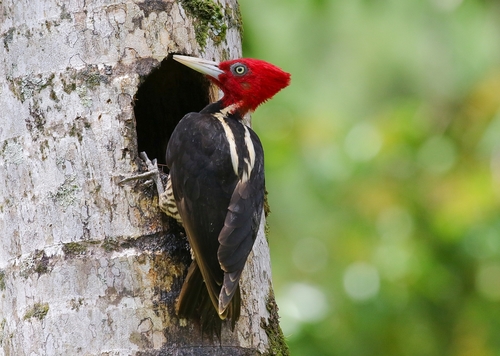
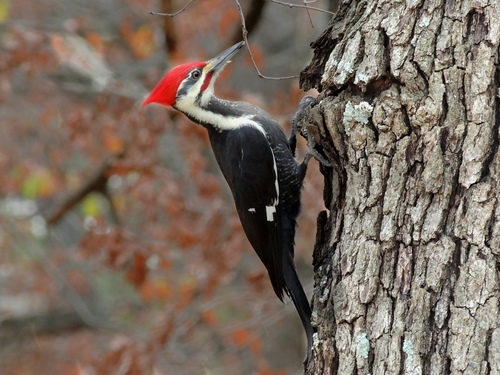
Dryocopus pileatus, commonly known as the pileated woodpecker, is primarily black with a red crest and a white stripe running down the sides of the throat. Adult males have a red stripe from the bill to the throat, while this stripe is black in adult females. They also have white wing feathers that are visible when the bird is in flight. Adult pileated woodpeckers measure 40 to 49 cm (16 to 19 in) in total length, with a wingspan of 66 to 75 cm (26 to 30 in), and weigh between 225 and 400 g (7.9 to 14.1 oz). The combined average body mass for both sexes is approximately 277 g (9.8 oz); males have a mean body mass of about 300 g (11 oz), while females have a mean body mass of about 256 g (9.0 oz). Individual body measurements are as follows: wing chord length ranges from 21.4 to 25.3 cm (8.4 to 10.0 in), tail length ranges from 14.0 to 17.4 cm (5.5 to 6.9 in), bill length ranges from 4.1 to 6.0 cm (1.6 to 2.4 in), and tarsus length ranges from 3.1 to 3.8 cm (1.2 to 1.5 in). Southern populations of pileated woodpeckers have ebony black feathers, have less white on wing-adjacent feathers, and are smaller overall than northern populations. Northern pileated woodpeckers are larger in wing, tail, and beak size; their feathers are a lighter black with brown and gray tinges, and they have whiter feathers on their flanks. Juvenile pileated woodpeckers typically have less curved crests, which some people call "mohawks". The flight of pileated woodpeckers is strong and direct, with the undulating pattern that is characteristic of woodpeckers. Two Old World Dryocopus species, the white-bellied woodpecker (D. javensis) and the black woodpecker (D. martius), are closely related to the pileated woodpecker, and occupy the same ecological niche in their respective ranges that the pileated woodpecker occupies in North America. The only North American birds with similar size and plumage to the pileated woodpecker are the ivory-billed woodpecker of the southeastern United States and Cuba, and the related imperial woodpecker of Mexico. The breeding habitat of the pileated woodpecker includes forested areas across Canada, the eastern United States, and parts of the Pacific Coast. This species favors mature forests and heavily wooded parks, and specifically prefers mesic habitats with large, mature hardwood trees, often occurring in large tracts of forest. However, they also live in smaller woodlots, called late-successional forests, as long as these woodlots contain a scattering of tall trees. Pileated woodpecker populations declined drastically in the 1700s and 1800s due to habitat loss, but have since recovered well. Pileated woodpeckers are considered ecologically essential to their habitats for multiple reasons: their tree carvings create nest cavities used by other species, they help control some insect populations, and they break off pieces of dying trees to speed up decomposition. Pileated woodpeckers feed mainly on insects, particularly carpenter ants and wood-boring beetle larvae. They are also known to eat fruits, nuts, and berries, including berries produced by poison ivy.