About Dryocopus martius (Linnaeus, 1758)
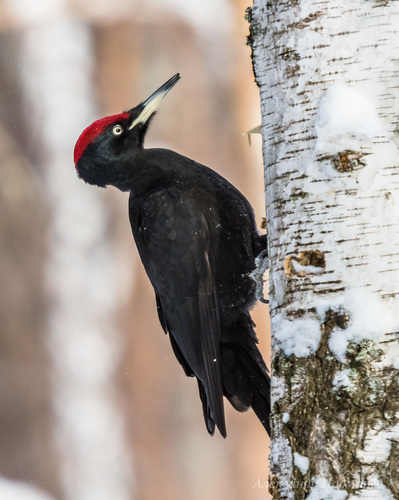
Dryocopus martius, the black woodpecker, measures 45 to 55 cm (18 to 22 in) long with a 64 to 84 cm (25 to 33 in) wingspan. Its average body weight is approximately 250 to 400 g (8.8 to 14.1 oz). Among standard measurements, the wing chord is 22.7 to 26 cm (8.9 to 10.2 in), the tail is 15.9 to 17.3 cm (6.3 to 6.8 in), the very long bill is 5 to 6.7 cm (2.0 to 2.6 in), and the tarsus is 3.6 to 4 cm (1.4 to 1.6 in). It is easily the largest woodpecker in its range. Among confirmed extant woodpecker species, it is second only in size to the great slaty woodpecker, following the likely extinction of the formerly largest and second largest woodpecker species. Its average mass is similar to that of the South American Magellanic woodpecker. Closely related pileated and white-bellied woodpeckers also broadly overlap in size with the black woodpecker, but both are somewhat smaller in average and maximal size and mass. This crow-sized woodpecker has entirely black plumage except for a red crown. In males, the entire crown is red, while in females only the top hindcrown is red, with the rest of the body all black. Juvenile black woodpeckers are similar to adults but are less glossy, with a duller red crown and a paler grey throat and bill. The black woodpecker's piercing yellow eyes and loud, high-pitched calls have made it the villain of fairy tales throughout its range. Its voice has two distinct calls. One is a short single high-pitched note, forming a loud, whistling kree-kree-kree, given only twice in a row. The other is a screech-like shrill call produced while in flight. Unlike other woodpecker species, the black woodpecker does not have a dipping, bounding flight; instead it flies with slow, unsteady-seeming wing beats with its head raised. The black woodpecker's range spreads east from Spain across almost all of Europe, excluding Great Britain, Ireland, and northernmost Scandinavia. It is also native to parts of Asia, including Korea, Japan and China, and to the Middle East, including Iran and Kazakhstan. The southern limits of this woodpecker's range are in Spain and Italy, and it has also been recorded as a vagrant in Portugal. The species is generally more uncommon and more discontinuous in distribution in the Asian part of its range. The black woodpecker is mainly found in forested regions, with a preference for extensive, mature woodland, including coniferous, tropical, subtropical and boreal forests. It is very widespread throughout mountainous and lowland forests. It is more likely to occur in marginal woods near human habitations during the non-breeding season. This species has been observed at elevations between 100 and 2,400 m (330 and 7,870 ft). The black woodpecker is noticeably absent from the British Isles. Approximately 80 sightings of the species in the UK have been reported, and some of these are disputed. Even so, the proximity of the British Isles to the species' range in Western Europe means the species may cross over on a regular basis. The black woodpecker feeds by using its bill to hammer on dead trees to dig out carpenter ants and wood-boring beetle grubs. Food selection is relatively predictable, narrow and consistent for this species. Like all woodpeckers, this species has a specially adapted neck with very strong muscles, which allow it to endlessly hack away at tree bark. Due to the size of its bill, its large body size, and its great physical power, it can access prey fairly deep within a tree. To position itself correctly, it has short, stumpy legs, as well as long, sharp claws and very stiff tail feathers. Black woodpeckers will most likely choose a tree with a fungal disease, such as heart rot, for nesting, although some will use a living, healthy tree. Once an entrance hole has been made, the black woodpecker chips downwards through the trunk of the tree, creating a nesting chamber, with only the woodchips created during the process as lining. The excavations made by black woodpeckers provide homes for many other species of bird and mammal, so the species is considered a "keystone" species in many of its habitats across its range. It not only provides habitats for other species, but also controls populations of wood-boring insects, helping to protect trees. When the nest is ready, the female lays a single clutch of two to eight eggs, with an average of four to six. The nest hole is usually dug in a live poplar or pine tree. The breeding pair take turns incubating the eggs, and also share the duties of feeding and brooding the chicks once they hatch. Nestlings may fight their way to the entrance of the nest in order to be fed first. After 18 to 35 days, the young black woodpeckers leave the nest, and stay with the adults for another week.