About Dryocampa rubicunda Fabricius, 1793
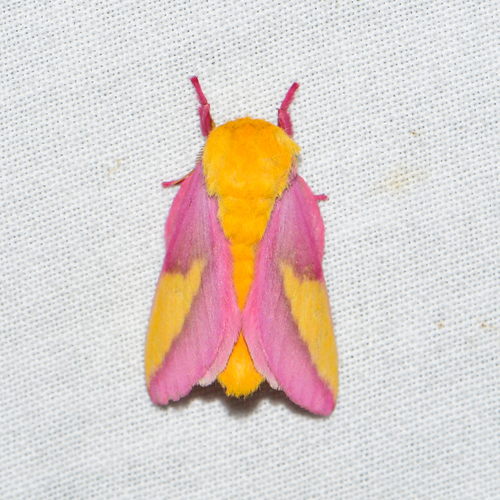
Dryocampa rubicunda, commonly known as the rosy maple moth, is the smallest silk moth species. Males have a wingspan ranging from 3.2 to 4.4 centimeters (1.25 to 1.75 inches), while females have a wingspan of 3.8 to 5 centimeters (1.5 to 2 inches). This species can be distinguished by its unique, variable pink and yellow coloration: it has reddish-to-pink legs and antennae, yellow bodies and hindwings, and pink forewings marked with a triangular yellow band across the middle. The rosy maple moth is distributed across eastern and northern United States, as well as adjacent areas of Canada. Its northernmost range extends into southern Canada, covering Ontario, Quebec, New Brunswick, Nova Scotia, and Prince Edward Island. To the south, its range reaches Dade County, Florida along the Atlantic coast of North America, and westward it extends from eastern Texas through Minnesota. Rosy maple moths inhabit temperate deciduous forests, as well as nearby suburban areas and urban landscapes. Their common name comes from their primary association with maple trees, including red maples (Acer rubrum), sugar maples (Acer saccharum), silver maples (Acer saccharinum), and box elder maples (Acer negundo). They can also be found on oak trees, particularly turkey oaks (Quercus laevis), most often when these oaks grow mixed among maple trees. Larvae hatch and remain on the same tree throughout their development, then pupate in the soil under that tree. Larvae feed mainly on the undersides of leaves, so they stay in this area of their host tree. Adult rosy maple moths do not feed, which allows them to have a relatively large home range. Rosy maple moths typically have a total lifespan of two to nine months. Between hatching and reaching adulthood, the species goes through five larval instars. Moths with longer lifespans spend most of this extra time as pupae over the winter.