About Dryobotodes eremita Fabricius, 1775
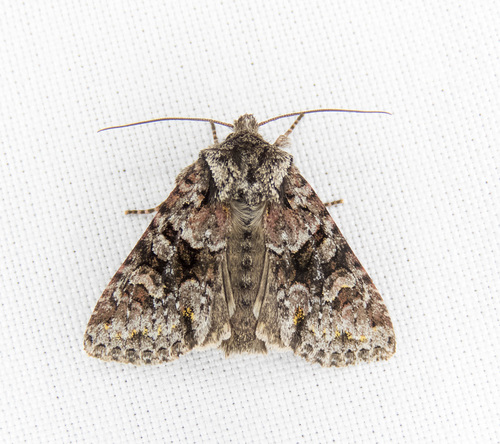
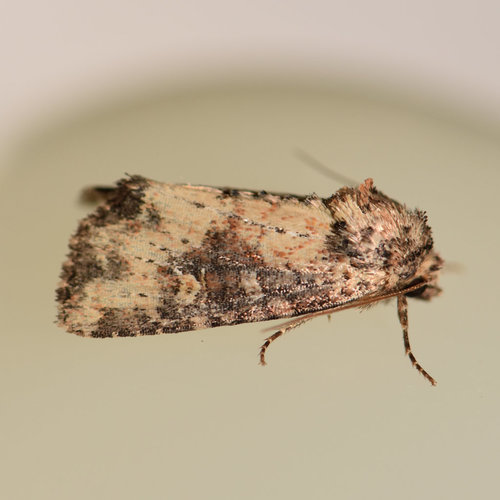
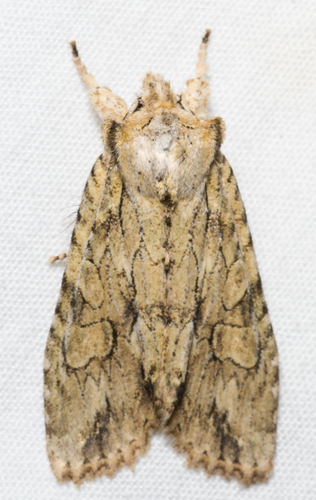
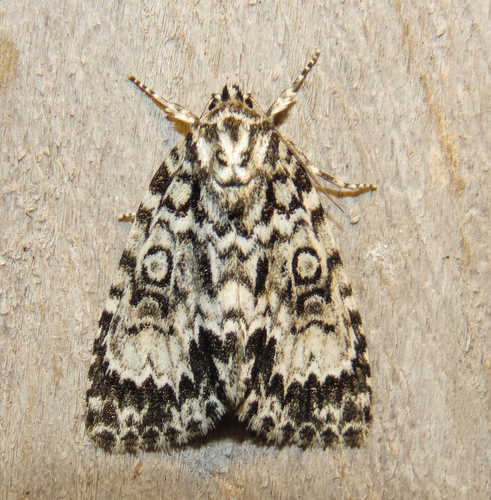
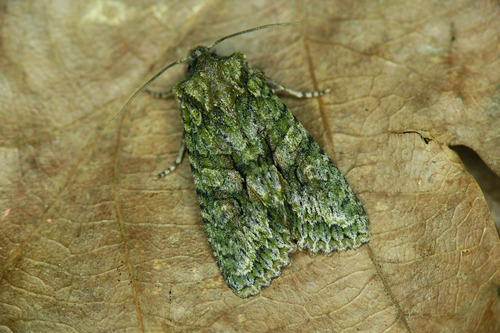
The wingspan of Dryobotodes eremita Fabricius, 1775 ranges from 32 to 39 mm. The forewing is olive green mixed with light or dark grey, with patches of pale brown or reddish colouring; these reddish tints appear along the two folds, giving the entire wing a mossy appearance. The lines are blackish and indistinct. There is a black streak between the inner and outer lines, below the claviform stigma, which is followed by a rufous patch. The upper stigmata are slightly paler grey, tinged with green or reddish. The submarginal line is pale, followed by blackish scaling on each fold. The hindwing is dull grey, with a darker cellspot, darker outer line, and a darker diffuse submarginal band. The variety variegata Tutt is much brighter and more colourful: dark shades, especially in the median area, are intensified, while paler areas including the stigmata, the inner margin on each side of the median area, and the space between the outer and submarginal lines are lightened. The apex is also prominently paler, and the terminal area is more largely blackened. The variety corsica Spul., from the island of Corsica, is a rough brownish-olive-green form. From Amasia, two forms first described by Warren are recorded: one, named grisea nov., has only dark and light grey colouring, with just the slightest trace of green or brown tints. A second form from Amasia, dejecta nov., is decidedly smaller, uniformly dark grey, with all markings more or less obscured and a darker hindwing. In contrast, grisea has conspicuous pale areas and a whitish hindwing. The aberration incolorata ab. nov., described by Warren, has a pale or dark grey ground colour, with no additional coloured tints except for a faint rufous flush along the two folds and the course of the submarginal line.