About Drymophila striaticeps Chapman, 1912
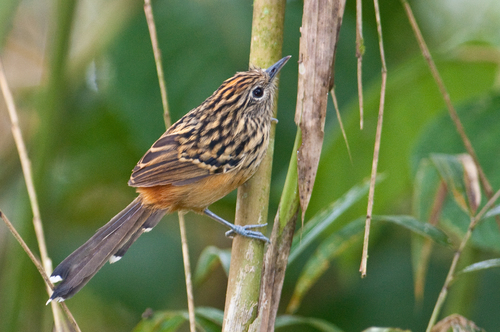
Drymophila striaticeps, commonly known as the streak-headed antbird, was first formally described by Chapman in 1912. This species measures 14.5 to 15.5 cm (5.7 to 6.1 in) in length and weighs 11 to 13 g (0.39 to 0.46 oz). Adult males have a black crown and back marked with white streaks, plus a distinct white patch between their scapulars. Their rump is deep rufous. Their flight feathers are black with rufous edges, while their wing coverts are black with white tips. Their tail is blackish gray, and each feather ends in a white tip. The male's face, throat, and breast are white with heavy black streaks; its belly is plain unstreaked white, and its flanks and crissum are rufous. Females share the same general patterning as males, but differ in coloration. The female's crown is streaked with cinnamon-rufous and black, and it lacks the white interscapular patch that males have. With the exception of the white tail tips, all regions that are white on males are rufous-buff on females. Females also have a rufous-buff tinge to their underparts, and their flanks are paler than those of males. The streak-headed antbird has a disjunct distribution across the Andes, split into three separate populations. The first population occurs in Colombia's Central Andes, on the west slope of Colombia's Western Andes, and extends south along the Andean west slope into central Ecuador. The second population is found on the east slope of the Western Andes, extending south along the Andean east slope through Ecuador into northern Peru, reaching as far as the Department of San Martín. The third population is located on the Andean east slope from the Department of Huánuco in central Peru southward into Bolivia's La Paz Department. This antbird lives in the understorey to mid-storey of montane evergreen forest and secondary forest. It particularly favors bamboo thickets, and occurs less often in other types of dense undergrowth such as vine tangles and shrubby forest edges. Its elevational range varies by country: between 1,200 and 3,150 m (3,900 and 10,300 ft) in Colombia, mostly between 1,500 and 2,600 m (4,900 and 8,500 ft) in Ecuador, and between 1,600 and 2,500 m (5,200 and 8,200 ft) in Peru.