About Drymophila squamata (Lichtenstein, 1823)
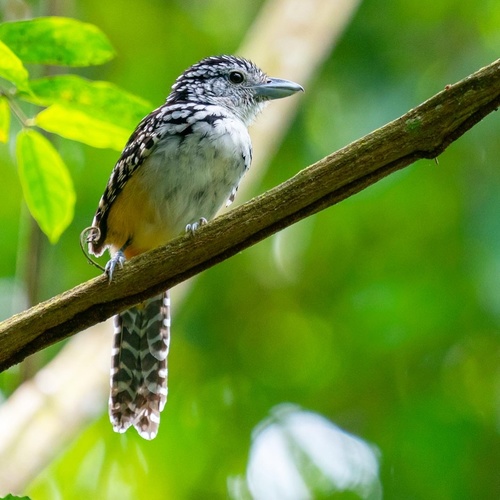
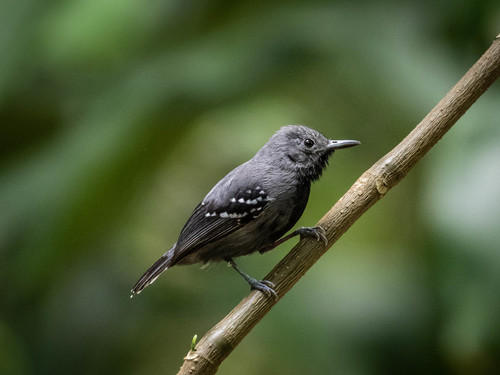
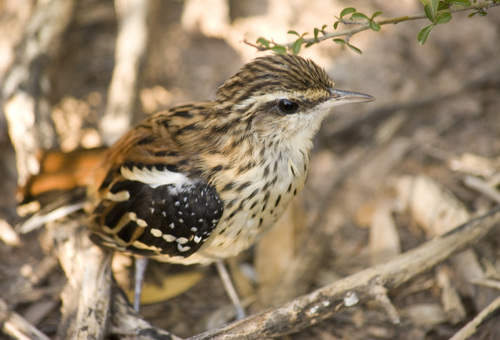
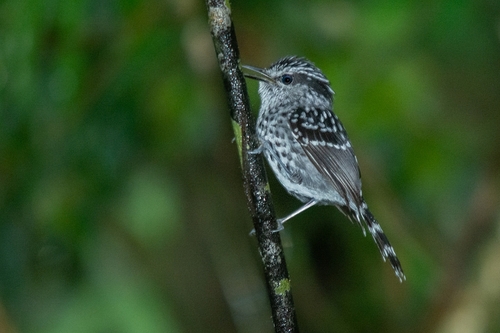
The scaled antbird, scientifically named Drymophila squamata (Lichtenstein, 1823), is 12 to 14 cm (4.7 to 5.5 in) long and weighs 10.5 to 11 g (0.37 to 0.39 oz). Adult males of the nominate subspecies have a black crown with white spots along its sides, a wide white supercilium, and a black stripe through the eye on an otherwise black-spotted white face. Their upperparts are black with white spots. Their wings are black, and their wing coverts are black with wide white tips. Their tail is barred black and white, and their throat and underparts are white with black spots. Females share the same general pattern as males but have different coloration: their crown and eye stripe are dark brown, their upperparts are dark brown with buff spots, their wing coverts are dark brown with buff tips, their tail is barred dark brown and buff, and their flanks and crissum are pale cinnamon. Males of the subspecies D. s. stictocorypha are similar to the nominate subspecies, but have white spots in the center of the crown and a darker gray belly. There is some observed overlap between the two subspecies. The scaled antbird is distributed across eastern and southeastern Brazil. The nominate subspecies occurs in the eastern portions of the states of Pernambuco, Alagoas, and Bahia. Subspecies D. s. stictocorypha occurs further south, from eastern Minas Gerais and Espírito Santo south into extreme northeastern Santa Catarina. This species inhabits the dense understorey of evergreen forest and secondary woodland. In some areas, it is often found in bamboo thickets, but it is just as commonly found away from bamboo; it is the only member of its genus that is not closely tied to bamboo. Its elevation range extends from sea level to 1,100 m (3,600 ft), and it tends to occur at higher elevations in the northern part of its range.