About Drymophila ferruginea (Temminck, 1822)
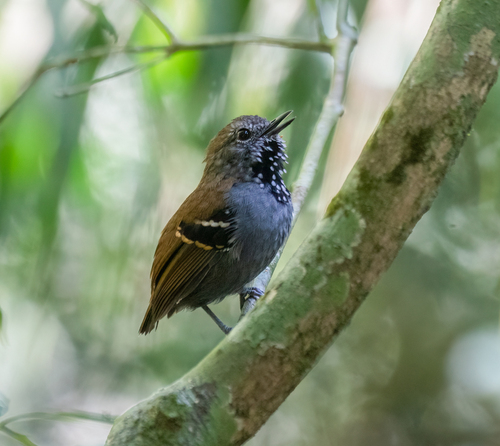
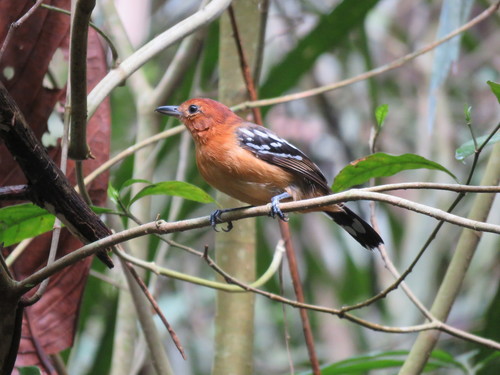
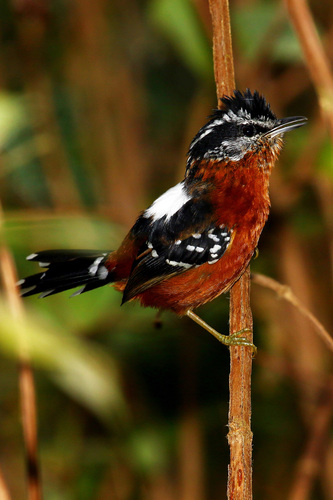
The ferruginous antbird (Drymophila ferruginea, first described by Temminck in 1822) measures 12 to 13 centimeters (4.7 to 5.1 inches) in length and weighs 9.5 to 11.5 grams (0.34 to 0.41 ounces). Adult males have a black crown, a white supercilium, a wide black band running through the eye, and white cheeks marked with black speckles. Most of their upperparts are reddish yellow-brown, with a usually hidden white patch between the scapulars and a rufous rump. Their wings are brownish black, with buffish edges on the flight feathers and wide white tips on the coverts. Their tail is black, with wide white tips on each feather. Their chin is white with black speckles, while their throat and underparts are rufous. Females have a similar overall appearance to males but are paler; they also have olive streaks on the crown, rufous tips on the wing coverts, and lack the white patch between the scapulars. Subadult males resemble adult females, but have an interscapular patch, wide buff edges on the crown feathers, a buff-tinged supercilium, and paler underparts. This species is found in southeastern Brazil, in a region roughly bounded by southeastern Bahia, northeastern Santa Catarina, east-central Minas Gerais, and western São Paulo states. It lives in stands of bamboo, most often along the edges of primary evergreen forest. It also occupies bamboo in secondary woodland, in tree-fall openings, and in standalone pure patches of bamboo. Most individuals occur between sea level and 1,200 meters (3,900 feet), but the species is occasionally found at elevations as high as 1,600 meters (5,200 feet).