About Drymonia dodonaea (Denis & Schiffermüller), 1775
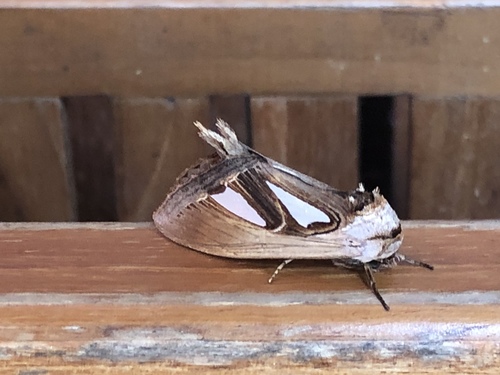
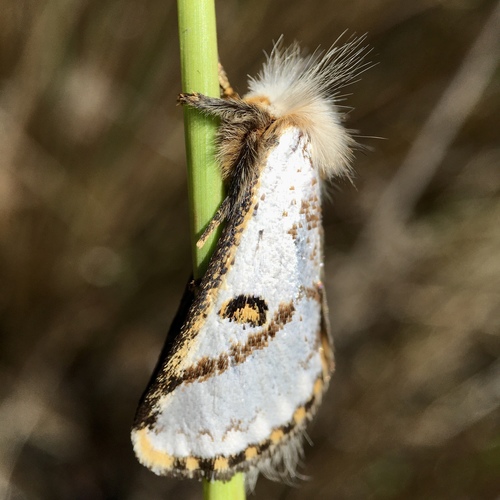
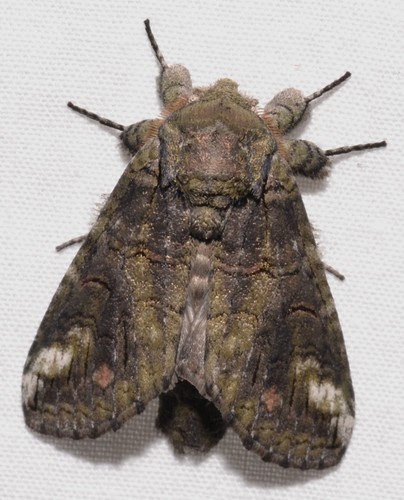
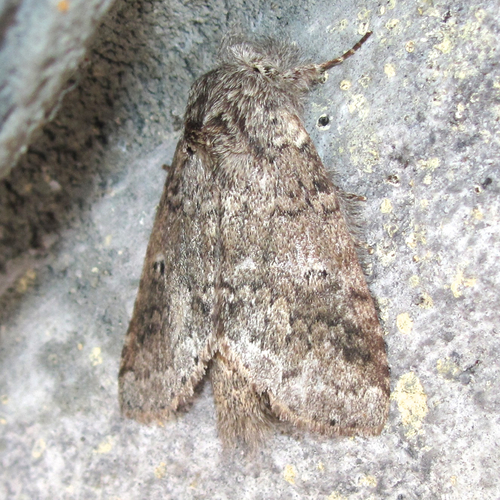
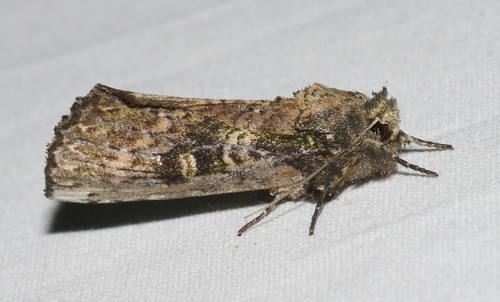
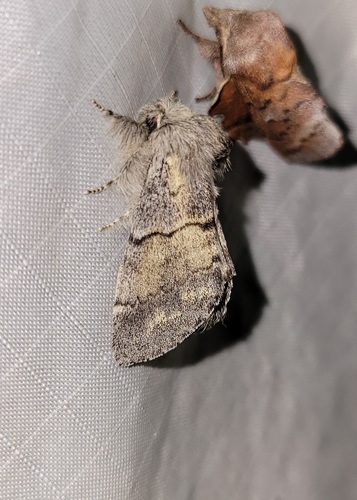
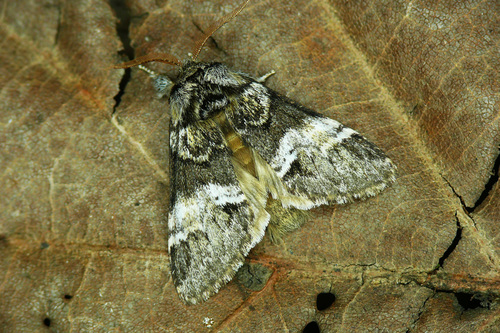
This moth species, Drymonia dodonaea, has a wingspan of 33–38 mm. It is similar to Drymonia ruficornis, but generally has whiter forewings, less straight crosslines, and lacks a black crescent above the center of the wings. The larva is naked, with no conspicuous outgrowths. It is yellow-green on the dorsum, has a yellow lateral stripe edged in red, and is bluish-green below this stripe. A technical description of the species notes that forewings are whitish grey, with two black basal dots, a broad transverse band that is constricted in the middle and edged with blackish scaling on its proximal side, and a distal dark dentate band that is broad at the costal margin, tapers to the hind margin, and forms an intensely black-brown angle-mark on vein 2. The distal margin has sharp dark brown spots. Hindwings are grey brown. The forewing marking pattern somewhat resembles that of the genus Cerura. The form ab. albida Rebel, a synonym of trimacula, has an entirely uniformly white median area on the forewing, aside from the two bands. In southern areas where the species occurs, a uniformly darker, usually somewhat smaller form, dodonaea Hbn sensu stricto, predominates. This form has a blackish grey-brown ground colour, with only the outer half of the median area forming a white band that is traversed by a blackish line accompanying the outer dark band. The extreme variant of this form is ab. fusca Rebel, which has uniformly black-grey forewings with no markings. The form that occurs in Eastern Asia, the southern Ussuri district, and Japan, dodonides Stgr. (now recognized as the full species Drymonia dodonides (Staudinger, 1887)), also differs from D. dodonaea by its uniformly darker colouring. Additionally, the outer transverse band and the proximal edge of the inner band are much more deeply dentate. Eggs are pale greenish, with fine minute punctures. Larvae are glossy light green, with two dorsal whitish longitudinal lines and a yellow stripe at the level of the spiracles; this stripe is often marked with red spots. Pupae are black-brown, with four small hooks at the anal end, and develop inside a silk-lined cell in the ground.