About Drymobius margaritiferus (Schlegel, 1837)
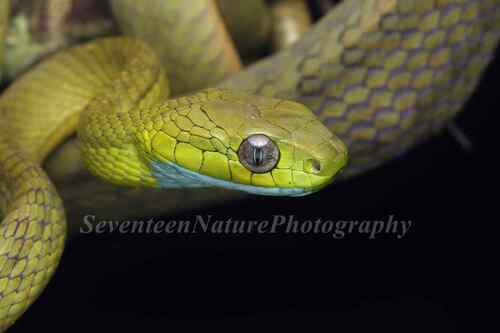
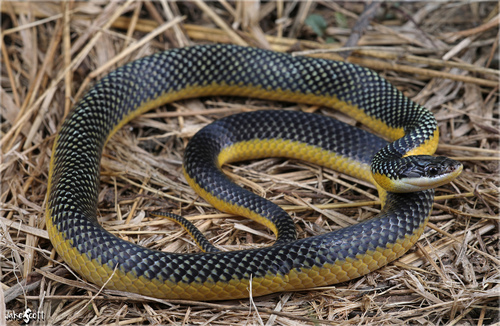
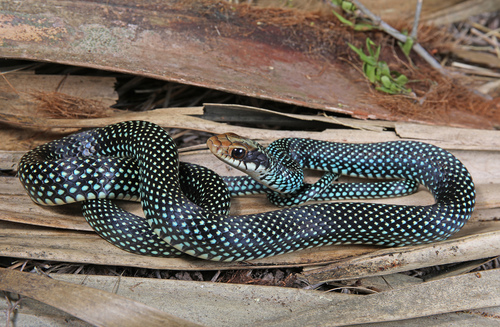
The speckled racer (Drymobius margaritiferus) is typically black, with distinctive yellow and blue spotting. It has one light-colored spot on each scale, which gives the snake an overall greenish hue. Its labial scales are yellow, with black sutures between the scales. The underside of the body is usually yellow to green. Adults average 30 to 40 inches (76 to 102 cm) in total length, and the largest recorded specimen measured 50 inches (127 cm). Its dorsal scales are arranged in 17 rows; they are weakly keeled along the middle of the back, but smooth on the sides. This species has 142 to 168 ventral scales, and 85 to 126 subcaudal scales.
This snake's distribution covers most of Central America. It ranges from the Isthmus of Tehuantepec and Yucatán Peninsula in Mexico southward to Panama, and into adjacent areas of northwest Colombia. In Mexico, it occurs northward into the coastal lowlands and lower outer slopes of the Sierra Madres, extending up the west coast to Sonora and up the east coast to northern Tamaulipas. The northern edge of its range reaches far southern Texas in the United States, where it is uncommon to rare in just a few of the state's southernmost counties. It occurs at elevations from sea level up to 4,750 feet (1,453 meters).
The speckled racer lives in a wide variety of habitats, including forests, forest edges, forest clearings, secondary growth, riparian zones, savannahs, marshlands, pastures, and roadsides. It is commonly reported to prefer humid, wet areas with permanent water sources. However, individual speckled racers have also been found in areas with no visible standing water, including tropical dry forests and tropical arid forests. In Costa Rica, this species is described as ubiquitous in all areas except the most humid lowland and pre-montane zones, including dry lowland forests.