About Drymoanthus adversus (Hook.f.) Dockrill
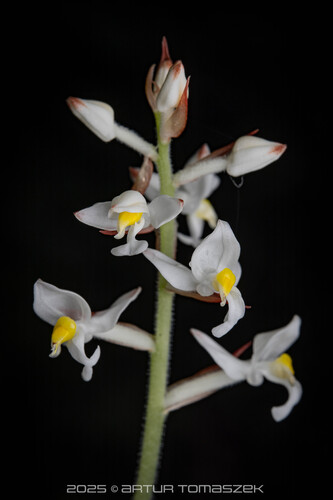
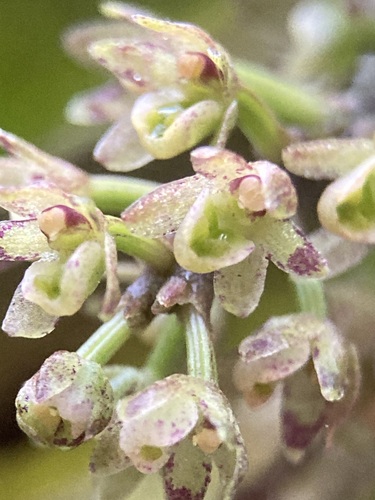
Drymoanthus adversus (Hook.f.) Dockrill has a growth form that resembles a small cluster of spider plants, with an overall diameter of approximately 4 to 15 centimeters. Its leaves are juicier and thicker than spider plant leaves, grow sparsely with very loose spacing between them, and resemble a miniaturized version of moth orchids. The leaves are thick, dark green, and sometimes marked with purple spots. They are consistently elliptical or round with sharp pointed tips, divided in half by a deep vein, and are slightly twisted rather than being fully flat. Leaves are arranged alternately, and the full set of leaves forms an overall "V" shape. The base of each leaf connects to the leaf sheath along a clearly defined abscission line, and older leaves droop slightly. The stem of D. adversus is very short, usually reaching only 5 centimeters in length. Fleshy aerial roots that anchor the plant grow from old stems that have already shed their leaves. Roots range in color from emerald green to grayish white, and aerial roots can grow quite long. The root system is mostly radiating and clings tightly to bark. Inflorescences grow opposite the tip of the plant, and often droop downward to form a raceme that is 80 millimeters long, holding 16 to 20 flowers. The flowers are green or greenish-white, marked with spots of red, chestnut, or purple. Sepals and petals are nearly equal in length, measuring approximately 3.5 millimeters long by 1.5 millimeters wide. The labellum (lip) is roughly the same length as the sepals and petals but wider, very fleshy, more or less upright, with a smooth convex outer surface and deep grooves. The middle lobe is free and forms only a small cup-shaped tip. After successful pollination, the plant develops a solid elliptical fruit with parallel grooves on its surface, marked with dark purple dots. Drymoanthus adversus is endemic to New Zealand, and is widely distributed across the country, ranging from Stewart Island in the far south to Motukokako Island (Piercy Island) in the far north. It is also found on the remote Chatham Island, as well as surrounding coastal areas and mountainous highlands across its range. In the North Island, it occurs mainly on the northernmost and southernmost peninsulas, and has not been recorded in multiple small areas centered around National Park, Waipukurau, and Blairlogie. In the South Island, it occurs mainly along the west coast and in mountains and forests from north to south. It is almost absent from the Canterbury Plain on the east coast, though a small number of individuals have been observed in Maungati and Dunedin. Drymoanthus adversus typically grows in moist forests near rivers or oceans, and inhabits tree trunks and branches on ridges covered in thin mist or cloud. It has a wide diversity of host plants, growing on the surfaces of many different plant species, including the vine Metrosideros fulgens, the shrub Lophomyrtus obcordata, and the tree fern Dicksonia squarosa. Observations by Cox & Lehnebach show that the population size of D. adversus increases as the surface area of the host increases. The species does not show preference for specific host species, instead preferring larger host size, and is most commonly found on larger trees. D. adversus often grows alongside mosses and lichens on tree trunks, and almost 90% of individuals come into direct contact with these non-vascular epiphytic plants. Moss can act as a substrate for the orchid to provide moisture. The lowest proportion of D. adversus individuals growing in contact with other such plants occurs on the shrub Olearia paniculata. Orchid roots of this species typically grow within lichens. Drymoanthus adversus flowers from September to January, following successful pollination. Fruit development begins from late December to January, and the fruit matures slowly. Around July, the fruit is fully ripe and begins releasing seeds. At this time, new racemes gradually develop and mature to prepare for the next pollination season. Seed release in D. adversus lasts for a long period, and is aided by the siphoning effect of fluff inside the fruit shell. Orchid seeds of this species are very small: they have discarded the cotyledons or endosperm that would normally provide nutrients for germination, and compress the embryo into a small cluster of cells with no embryonic roots or buds. This reduces the energy cost of producing individual seeds, allowing for higher seed production, and resulting in large quantities of dust-like seeds that can spread long distances by wind. Because orchid seeds must form a symbiotic relationship with fungi (which may be multiple fungi or a specific fungus) to germinate and develop, most seeds fall close to the parent plant, which gives them a higher survival rate. Many seedlings can be observed growing below the horizontal plane of host branches.