About Drymarchon couperi (Holbrook, 1842)
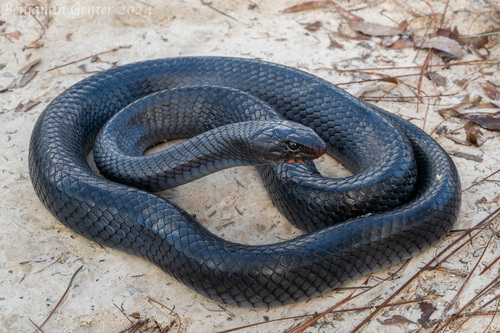
The eastern indigo snake (Drymarchon couperi) has uniformly blue-black dorsal scales. Some individuals have reddish-orange to tan coloring on the throat, cheeks, and chin. Its common name comes from its glossy, iridescent dorsal and ventral scales, which appear blackish-purple in bright light. This smooth-scaled species is considered the longest native snake species in the United States. The longest recorded specimen had a total length (including the tail) of 2.8 m (9.2 ft). Unlike many snake species, mature male eastern indigo snakes are slightly larger than females, a difference thought to stem from intraspecific competition and combat among males. A typical mature male measures 1.2–2.36 m (3.9–7.7 ft) in total length, with a reported average of 1.58 m (5.2 ft), and weighs 0.72–4.5 kg (1.6–9.9 lb), with a reported average weight of 2.2 kg (4.9 lb). Males longer than 1.2 m (4 ft) usually have weak keels on mid-dorsal scale rows 3 to 5, a trait females do not have. Mature females typically measure 1.1–2 m (3.6–6.6 ft) in total length, averaging 1.38 m (4.5 ft), and weigh 0.55–2.7 kg (1.2–6.0 lb), with an average weight of 1.5 kg (3.3 lb). Specimens over 2.6 m (8.5 ft) can weigh up to 5 kg (11 lb). While the average body mass of eastern indigo snakes is similar to that of the sympatric, venomous eastern diamondback rattlesnake, extremely large eastern diamondback rattlesnakes can outweigh big eastern indigo snakes. The eastern indigo snake’s current geographic range extends from Florida to southern Georgia and Alabama. Its historic range once reached into Louisiana, Mississippi, and South Carolina. A related subspecies, the Texas indigo snake (Drymarchon melanurus erebennus), is found in southern Texas and Mexico. Eastern indigo snakes most often occupy flatwoods, hammocks, dry glades, stream bottoms, cane fields, riparian thickets, and high ground with well-drained, sandy soils. In Georgia, the species prefers excessively drained, deep sandy soils along major streams, as well as xeric sandridge habitats. In the northern parts of its current range, it is restricted to sandhills and relies on gopher tortoise burrows during colder seasons. Xeric slash pine plantations appear to be preferred over undisturbed longleaf pine habitats. Habitat selection changes with the season. From December to April, eastern indigo snakes prefer sandhill habitats; from May to July they move from winter dens to summer territories; from August through November they are found more often in shady creek bottoms than in other seasons. A study conducted in Georgia recorded that winter sightings of the species generally occurred on sandhills, in association with gopher tortoise (Gopherus polyphemus) burrows. These burrows provide cover from predators, fires, and extreme regional temperatures. The eastern indigo snake is most abundant in the sandhill plant communities of Florida and Georgia. These communities are primarily scrub oak-longleaf pine (Pinus palustris) with occasional live oak (Quercus virginiana), laurel oak (Q. laurifolia), Chapman's oak (Q. chapmanii), and myrtle oak (Q. myrtifolia). Other plant communities the species occupies include longleaf pine-turkey oak (Q. laevis), slash pine-scrub oak (Pinus elliottii), pine flatwoods, and pine-mesic hardwoods. The eastern indigo snake is oviparous. Its eggs measure 75–100 mm (3–4 in) long by 27–32 mm (1–1 1⁄4 in) wide. Females lay a single clutch of 4 to 14 eggs between late April and early June. Hatchlings are 600–700 mm (23 1⁄2–27 1⁄2 in) long. Eastern indigo snakes are classified as late-maturing colubrids; they usually do not reach maturity until they are 3 to 5 years old and around 5 to 6 feet in length. Female eastern indigo snakes can retain live sperm for long periods, potentially over 4 years, allowing them to choose when to release sperm to fertilize their eggs. Mating peaks from November to January, but can occur any time from October through March. Like all snakes, the eastern indigo snake is carnivorous, and eats any small animal it can overpower. It kills some prey by pressing it against the walls of nearby burrows. Captive specimens are often fed dead prey to avoid injury to the snake from this method of subduing prey. Chemosensory research using mice (Mus musculus) found that D. couperi responds with significantly increased rates of tongue flicking and investigation toward visual prey cues, rather than volatile chemical cues. The species practices ophiophagy, eating other snakes including venomous species, as it is immune to the venom of North American rattlesnakes. The eastern indigo snake’s diet also includes turtles, lizards, frogs, toads, fish, a variety of small birds and mammals, and eggs. When threatened, the eastern indigo snake flattens its neck vertically, hisses, and vibrates its tail as a defensive display. It seldom bites if picked up. It often shares burrows with gopher tortoises, but will use armadillo holes, hollow logs, and debris piles when gopher tortoise burrows are unavailable. Hunters hoping to flush out rattlesnakes often accidentally kill eastern indigo snakes when they illegally pour gasoline into gopher tortoise burrows, a practice called 'gassing', even though gopher tortoises themselves are endangered and protected.